
Part 4 of the Pi Edge Series. New to the series? Start with
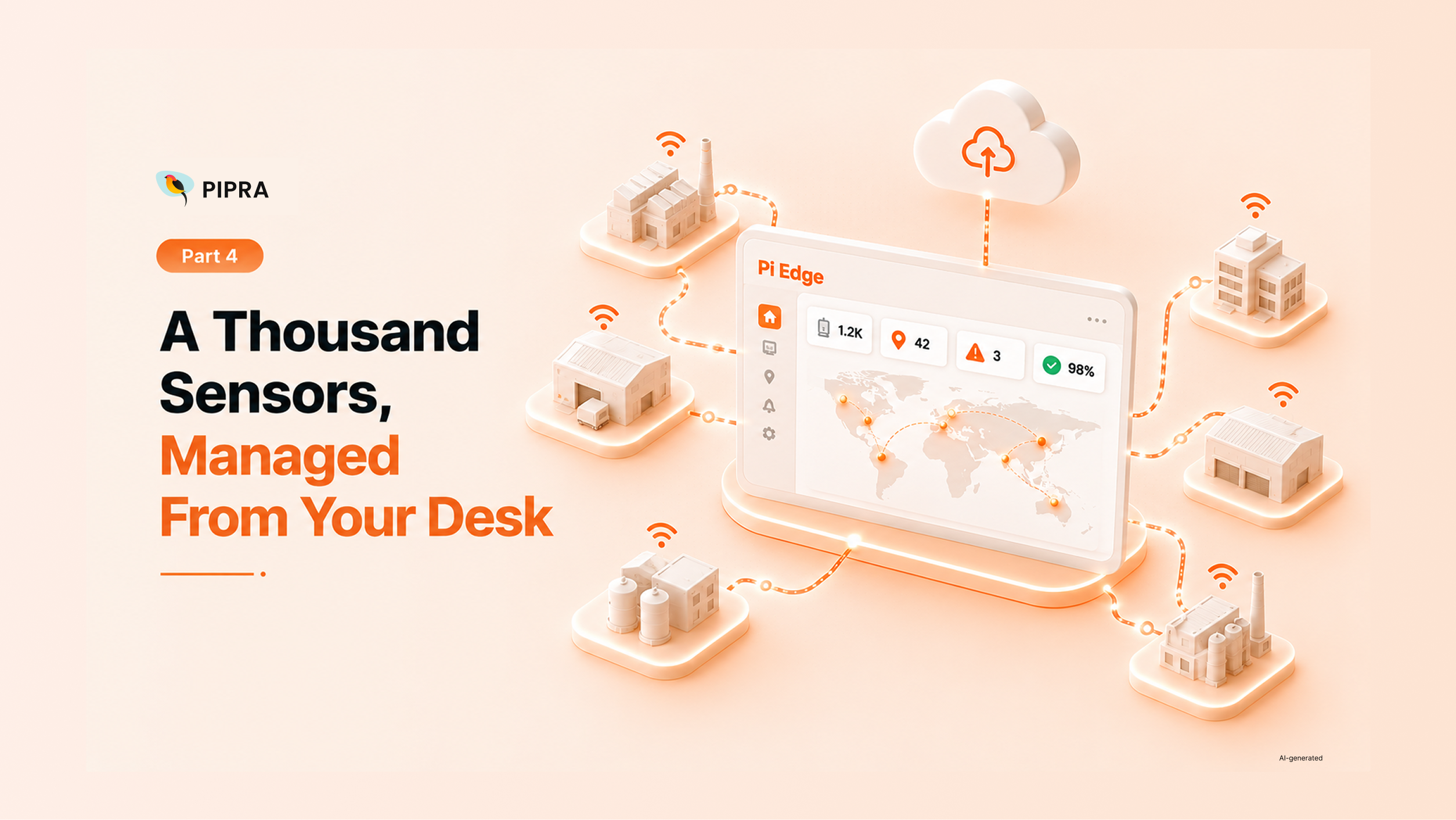
Pi Edge is PIPRA's IoT and edge intelligence platform it connects your sensors and site data, lets you monitor everything from one place, and alerts you before small issues become costly problems, scaling from one site to many at your own pace. This post covers what changes once you're not managing ten devices but a thousand, spread across many sites: updating software, checking on device health, and knowing the moment something goes quiet, all without a site visit.
The benefit: operating costs that don't scale with your fleet size, better operational control across every site, and no single person's memory as a point of failure.
Most connected projects don't fail at the pilot. They fail shortly after it.
The pilot goes well. Ten devices, one site, everyone impressed. So it's approved for the whole operation and somewhere between the tenth device and the two hundredth, the thing that made the pilot work quietly stops working. Not the technology. The approach.
Because at ten devices, everything can be handled personally. Someone knows each one. Problems are noticed because someone happens to look. Updates are done by visiting.
At a thousand, spread across sites in different regions, none of that survives contact with reality. Nobody can know each device. Nobody is looking at all of them. And "visit each one" stops being a plan and becomes a budget line nobody will approve.
This post is about what changes at that scale, and what the product does about it.
Three things break, and they break in a specific order.
At ten devices, you notice when one goes quiet. At a thousand, you don't find out weeks later when someone asks why a report looks odd, and by then you've lost weeks of data you can't recover.
At one site, a visit is an inconvenience. Across forty sites in three regions, routine visits are the single largest cost of running the fleet, and they're the reason improvements stop happening every change means travel, so changes stop being proposed.
At ten devices, one person holds it all in their head. At a thousand, that person is a risk. When they're on leave, changes wait. When they leave the company, a portion of your operation becomes something nobody fully understands.
Everything below exists to keep those three from breaking.
Connected devices need updates improvements, fixes, occasionally something urgent. The question is what an update costs you.
If it means a site visit, updates effectively stop happening. They get deferred, batched into some future maintenance window, and eventually a meaningful part of your fleet is running software from years ago that nobody wants to touch. That's not negligence; it's what happens when the cost per update is a day of someone's time and a tank of fuel.
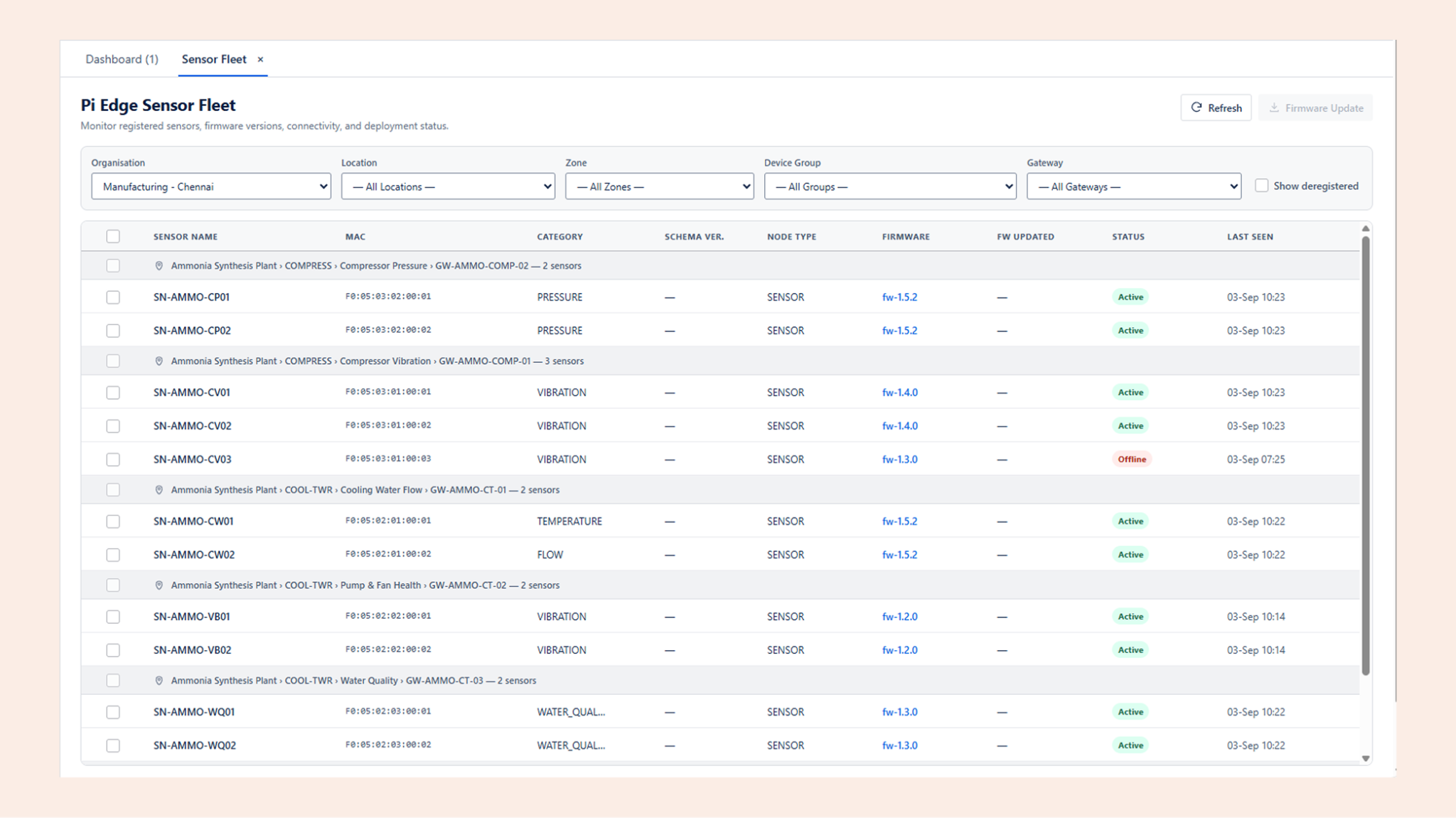
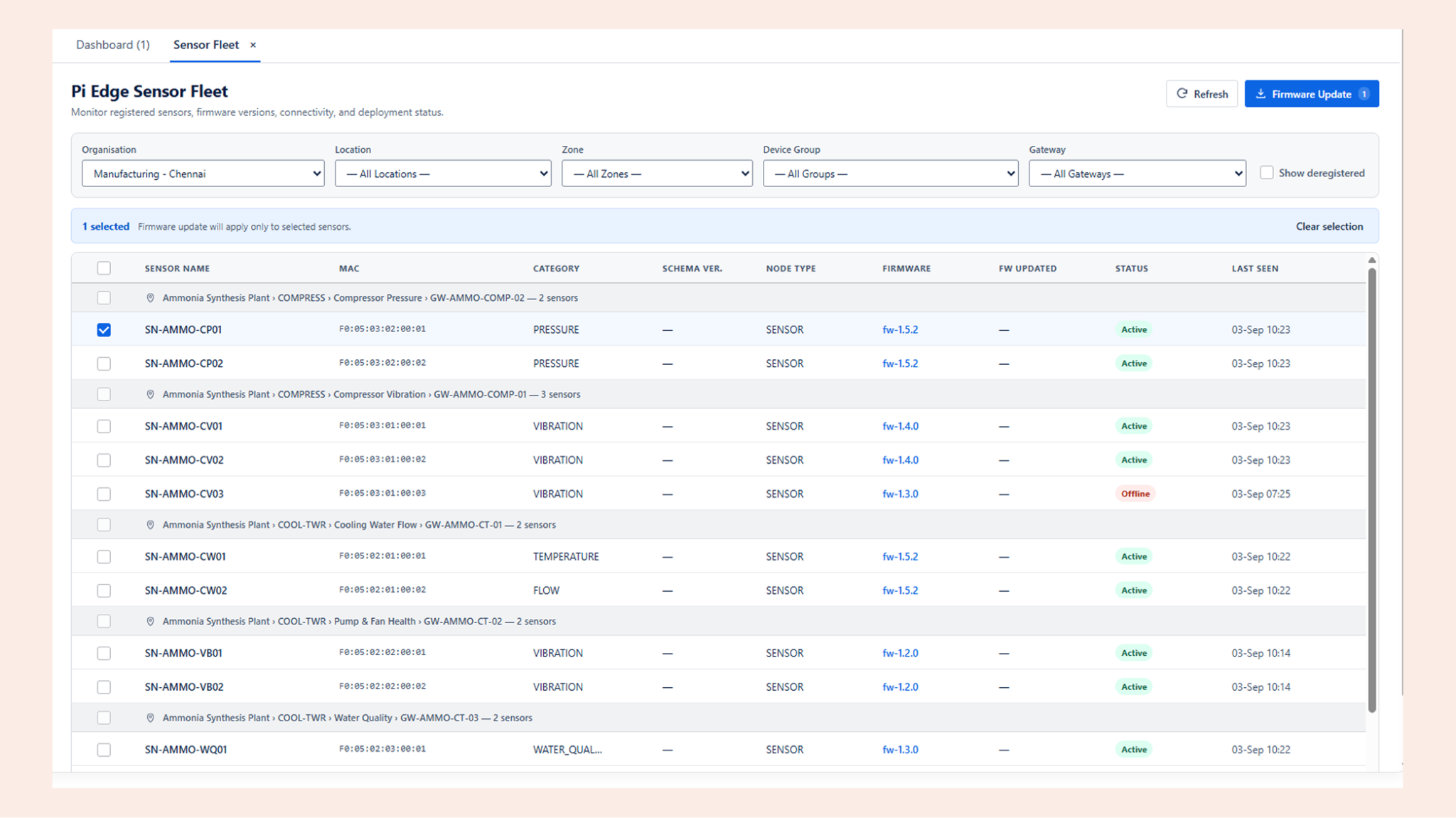
In Pi Edge, an update is something you do from a browser. You choose which devices one, a group, everything in a region and send it. The devices take it from there, and you watch the progress in the same view.
The practical effect is that updating stops being an event. It becomes routine, which means it actually happens, which means your fleet stays current instead of slowly drifting into a state nobody can account for.

Sometimes you don't need to change anything. You just need to know whether a particular device is healthy is it under strain, is it running out of room, is it coping.
Traditionally this means either a site visit or a specialist connecting to it directly, which puts a small question behind a large obstacle. So the question doesn't get asked, and small problems get to grow into large ones unobserved.
Pi Edge lets you simply ask. Select a device, request its health, and it reports back. No visit, no specialist, no waiting for someone with the right access to be available.
It's a small capability that changes behaviour: when checking is easy, people check. Problems get caught while they're still small and boring.
This is the one that matters most, and it's the least visible.
Devices in your operation check in regularly a steady signal that they're alive and working. If one stops, the system notices and flags it, without anyone needing to be watching.
The value here isn't the notification. It's the elimination of the silent gap. In systems without this, a device that fails simply... stops appearing. No error, no alarm, because nothing failed loudly something just stopped happening. The data quietly ends, and everyone downstream carries on assuming no news is good news.
That gap is how organisations discover, months later, that a critical measurement point hasn't reported since March. With automatic detection, you find out the same day, while the reason is still findable and the data loss is still measured in hours.
At scale, "who changed what, when" stops being a curiosity and becomes an operational necessity.
Something behaves oddly at a site. The first question is always what changed and if the honest answer is "we're not sure," you're now troubleshooting blind, guessing at history rather than reading it.
Every remote action taken in Pi Edge is recorded against the device it affected: what was sent, when, and whether it succeeded. When you open a device, you can see its history without asking anyone or trusting anyone's memory.
This also dissolves the knowledge problem. The history doesn't live in one person's head, so it doesn't leave when they do. Anyone with access can see exactly what has happened to any device, whether or not they were there at the time.

The last thing worth saying about scale is what doesn't happen.
There's no point in the growth curve where you outgrow the approach and have to start again. The system that ran your ten-device pilot is the same one running a thousand devices across regions same screens, same process, same records, with the pilot's own history still intact inside it.
That matters more than it sounds, because the alternative is common: organisations pilot on something small and convenient, prove the value, and then discover the real rollout needs an entirely different platform at which point the pilot's momentum, data, and goodwill are all spent on a migration nobody planned for.
Everything above depends on one thing: the device you're updating is the same device that was discovered on day one, in the same place in your structure, with its full history attached.
That's only true when it's all one platform. Assemble the same capabilities from separate tools and you get separate lists of devices that have to be kept in agreement and at a thousand devices, they won't be. The tools will disagree, and reconciling them becomes somebody's permanent job.
If your connected operation is currently limited by how many sites someone can physically get to, that's the constraint worth removing and we'd be glad to show you what removing it looks like.
Next in the series: turning all of those readings into a warning that arrives before something breaks.