
Part 2 of the Pi Edge Series - New to the series? Start with
Pi Edge is PIPRA's IoT and edge intelligence platform it connects your sensors and site data, lets you monitor everything from one place, and alerts you before small issues become costly problems, scaling from one site to many at your own pace.
This post covers the very first step in that journey: how a brand-new device goes from a box on a shelf to a live, working part of your site, without anyone at the site needing to be technical. The benefit: faster rollouts and low-complexity deployment - no specialist required on site, and every device accounted for from day one.
Think about the last time a new piece of connected equipment was installed at one of your sites.
Someone had to be physically present. They needed the right details written down somewhere-an address, an identifier, a location code. They probably needed a laptop, and possibly a phone call to whoever maintains the system to confirm a setting. If anything didn't match what was expected, the visit ended without the device working, and a second visit got scheduled.
Now multiply that by every device you plan to install this year. This is the quiet cost of connected operations, and it rarely appears in any budget. It's not the price of the hardware. It's the hour per device, the travel, the coordination between the person on site and the person who knows the system-and the fact that this cost scales linearly with your ambitions. Pi Edge removes that hour. Here's what happens instead.
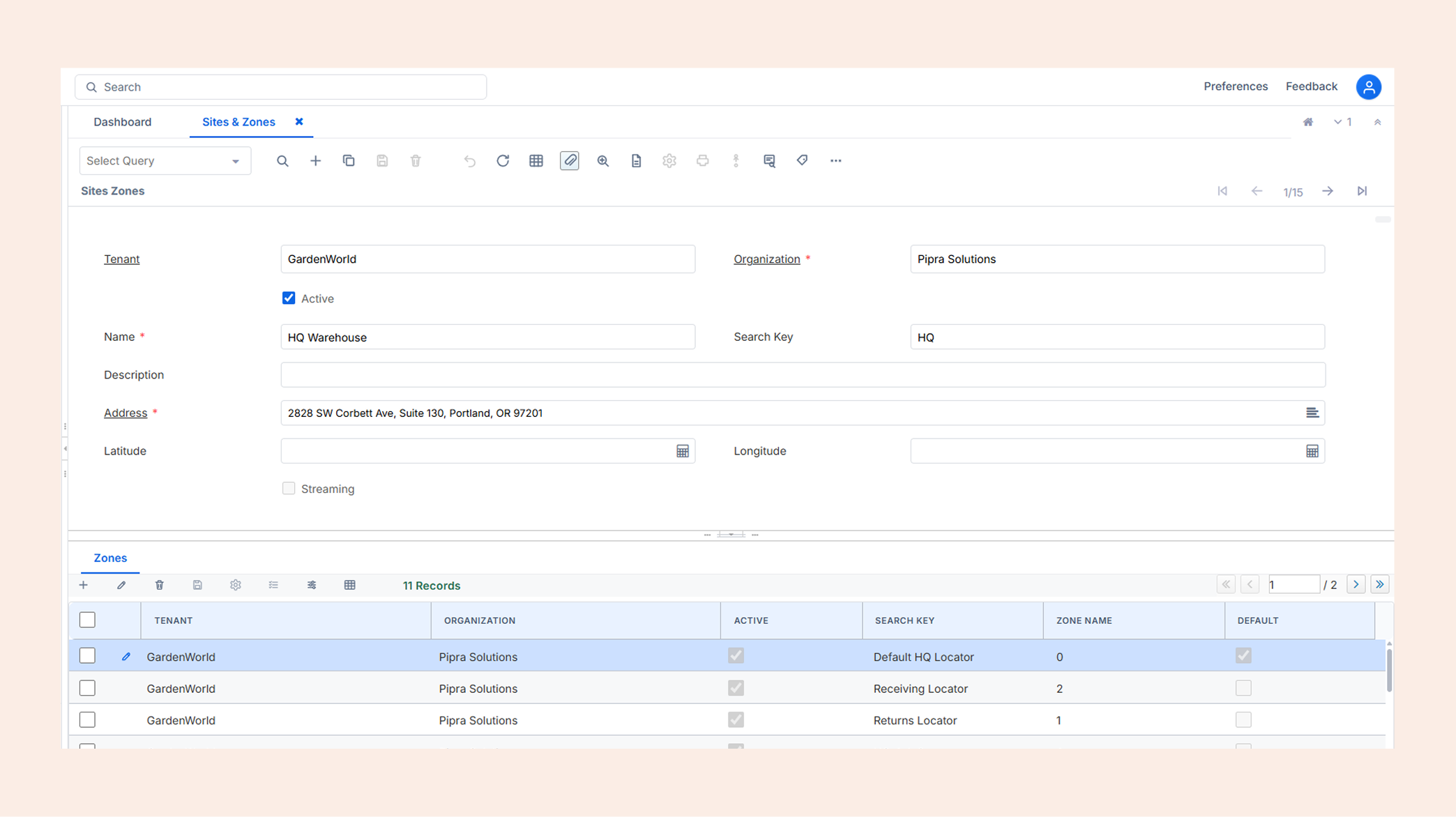
Before any hardware arrives, your operation is already described in the system: your organisation, its sites, the zones within each site, and the groups of equipment being monitored in each zone.
This sounds like paperwork. It's actually the thing that makes everything afterwards effortless.
Because the structure exists first, a device never needs to explain where it is or what it belongs to. When someone brings it into service, they're not filling in a form from scratch - they're picking from a structure that already reflects how your operation genuinely works. A sensor isn't just "sensor 47." It's a sensor in the bagging area of the fertiliser plant, in the group that watches the sealing machines.
That context follows the device for the rest of its life. Every list, every alert, and every report can be filtered by it, and the people at one site see their own equipment rather than everyone's.
Here's the part that surprises people.
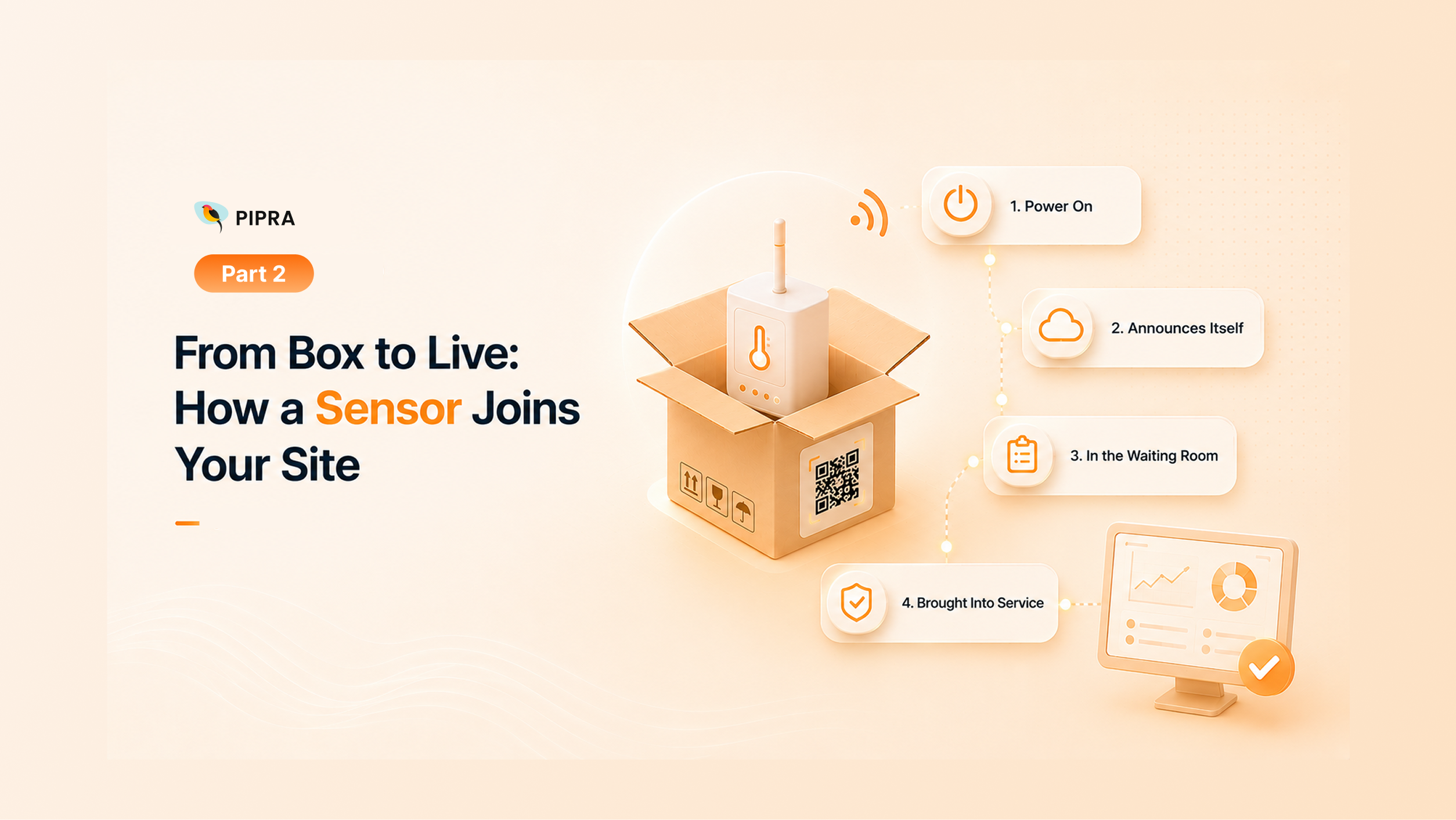
You switch the device on. That's the entire on-site procedure.
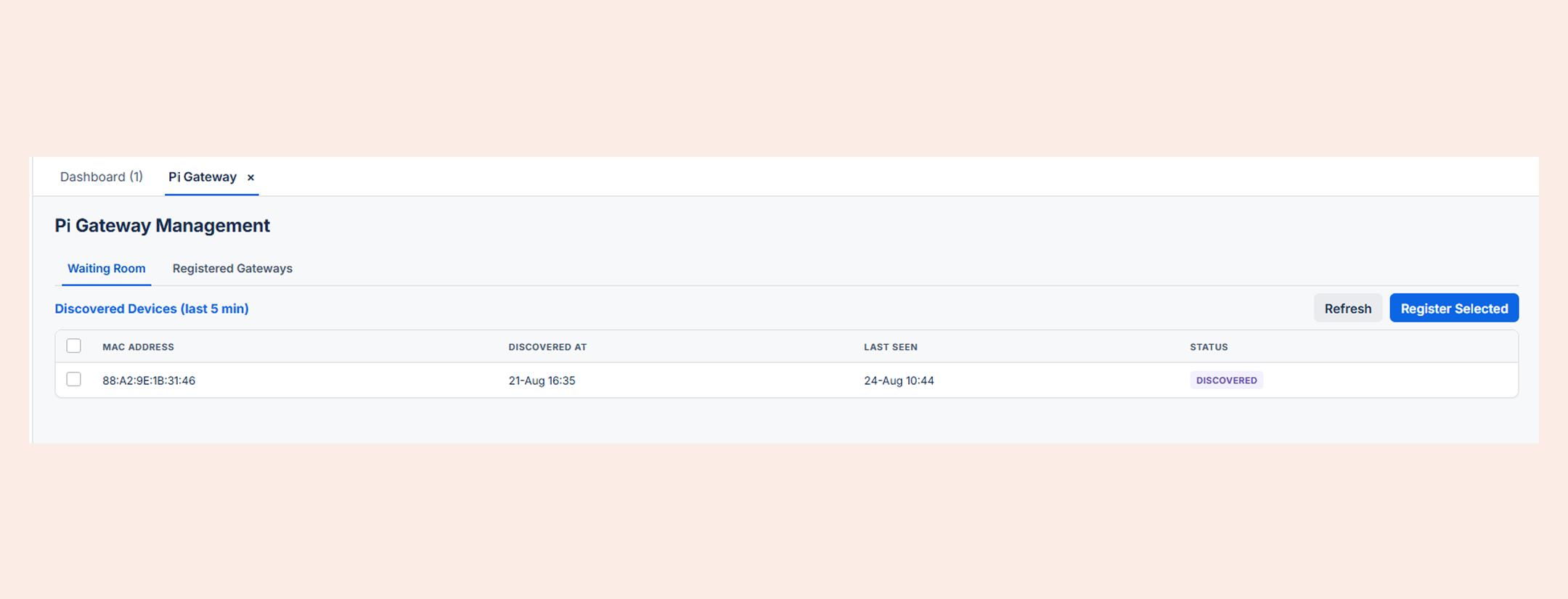
The moment it has power and a connection, the device introduces itself to your system - automatically. Nobody types in an address. Nobody loads a configuration file. Nobody needs to know anything technical about it in advance. Within moments of powering on, it appears in your system as something new, waiting to be brought into service.
The person at the site doesn't need to be the person who understands the system. They need to be the person who can plug something in. That single change is what makes rolling out hundreds of devices realistic rather than theoretical.
New devices land in what we call the Waiting Room-a live list of hardware that's announced itself but isn't yet in service.
It's exactly what it sounds like. Whoever is responsible opens it and sees what's arrived. They can bring devices into service one at a time, or select a batch and do them together-which matters when a shipment of thirty sensors arrives at once and you'd rather not repeat yourself thirty times.
The Waiting Room also protects you from a mistake that's easy to make: a device already working in your operation is never disturbed by announcing itself again. Power cuts happen. Devices restart. None of that resets anything or creates confusion in your records.
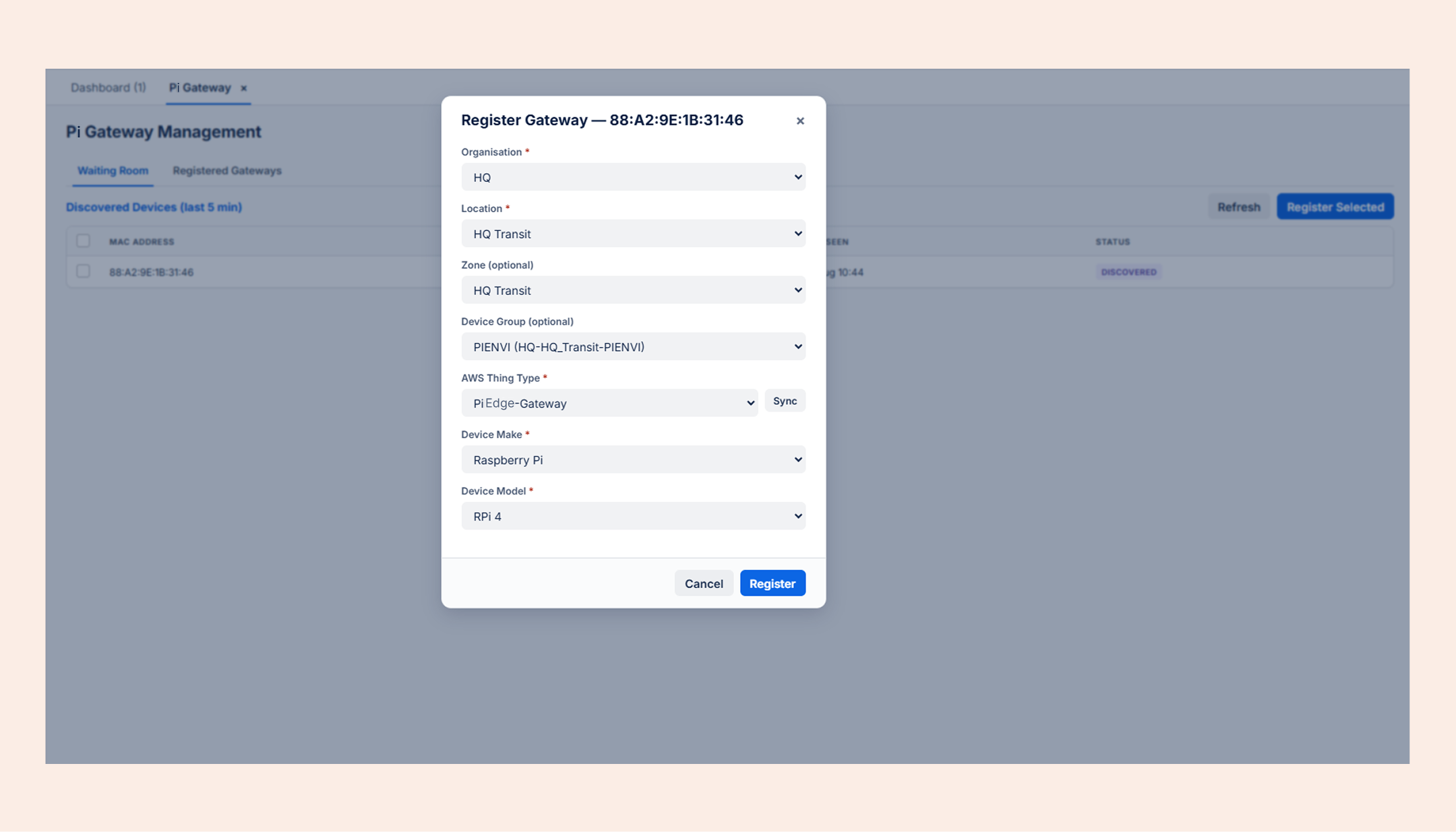
Bringing a device into service takes about as long as reading this section.
You pick it from the Waiting Room, say where it belongs in your structure, note what kind of hardware it is, and confirm. The system handles everything else-including securing the device properly, which is the part most people would rather not have to think about, and the part most commonly done badly when it's left to a manual process.
From there, you can watch its progress. The device moves through clearly labelled stages as it gets itself ready, and once it's live it starts checking in regularly. There's never a moment where
Real deployments are messier than demonstrations. Someone starts bringing a device into service, gets interrupted, and never comes back to it. The hardware turns out to be faulty. A shipment arrives at the wrong site.
Systems that don't plan for this accumulate debris-half-finished records that nobody wants to touch because nobody's sure what they'd break by deleting them. Over a few years, that debris becomes its own problem.
Pi Edge cleans up after itself. A device that never completes the process is tidied away automatically, and if that hardware later turns up at another site and gets switched on, it simply announces itself again as something new. No stale records, no manual housekeeping, no growing list of things nobody can explain.
This one sounds obvious until you've seen it go wrong.
A device needs to be recognised as the same device every time it's seen - regardless of whether it was moved, restarted, renamed by whoever installed it, or reconnected after a month offline. When a system gets this wrong, one physical sensor quietly becomes two records, its history splits in half, and its readings stop making sense in ways that take a long time to notice and longer to untangle.
Pi Edge ties identity to the hardware itself, not to a label someone typed. A device that's moved from one site to another is still recognisably the same device. A device that comes back after a long silence picks up its own history rather than starting a new one.
It's not a feature anybody asks for in a sales conversation. It's a feature you'd notice the absence of for years.
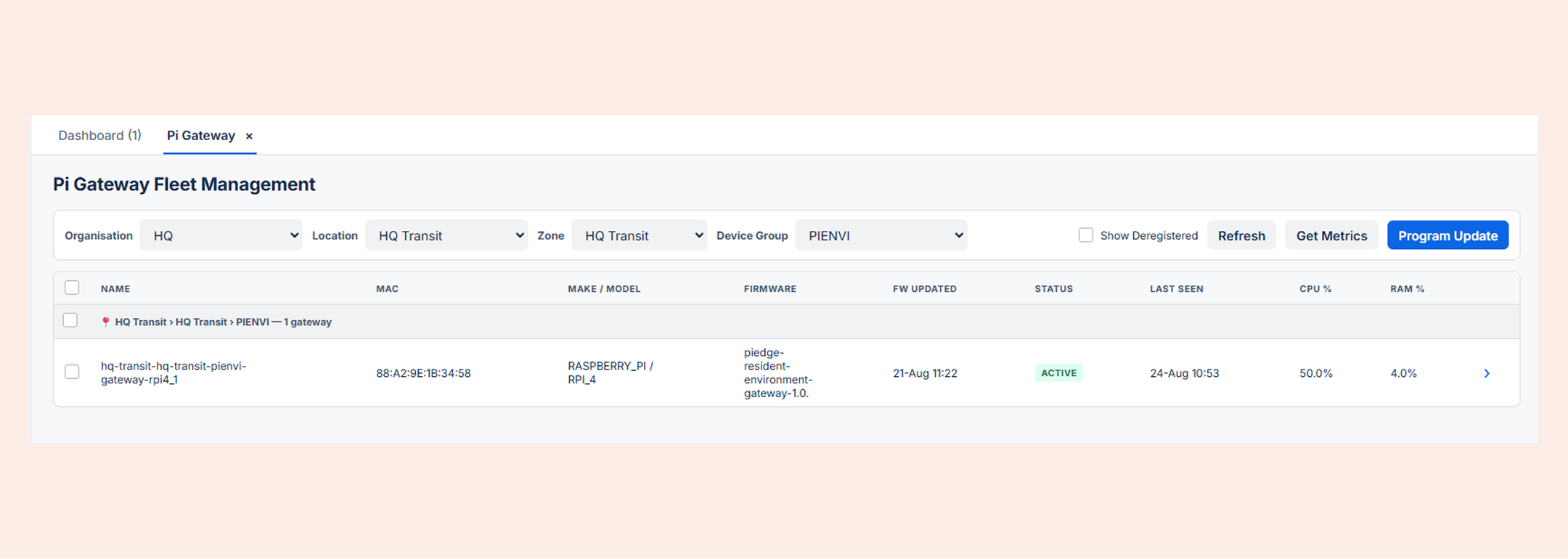
The reason all of this works is that discovery isn't a separate tool bolted onto the front of everything else. The device that announces itself in the first minute is the same device you'll update remotely next year and get an alert about the year after with the same identity, the same place in your structure, and the same history throughout.
Nothing gets re-entered. Nothing gets re-integrated. There's no point in the journey where a device has to be handed from one system to another and something gets lost in the handover.
If getting new equipment into service currently means a site visit, a specialist, and an hour you'd rather spend elsewhere, we'd be glad to show you the alternative running.
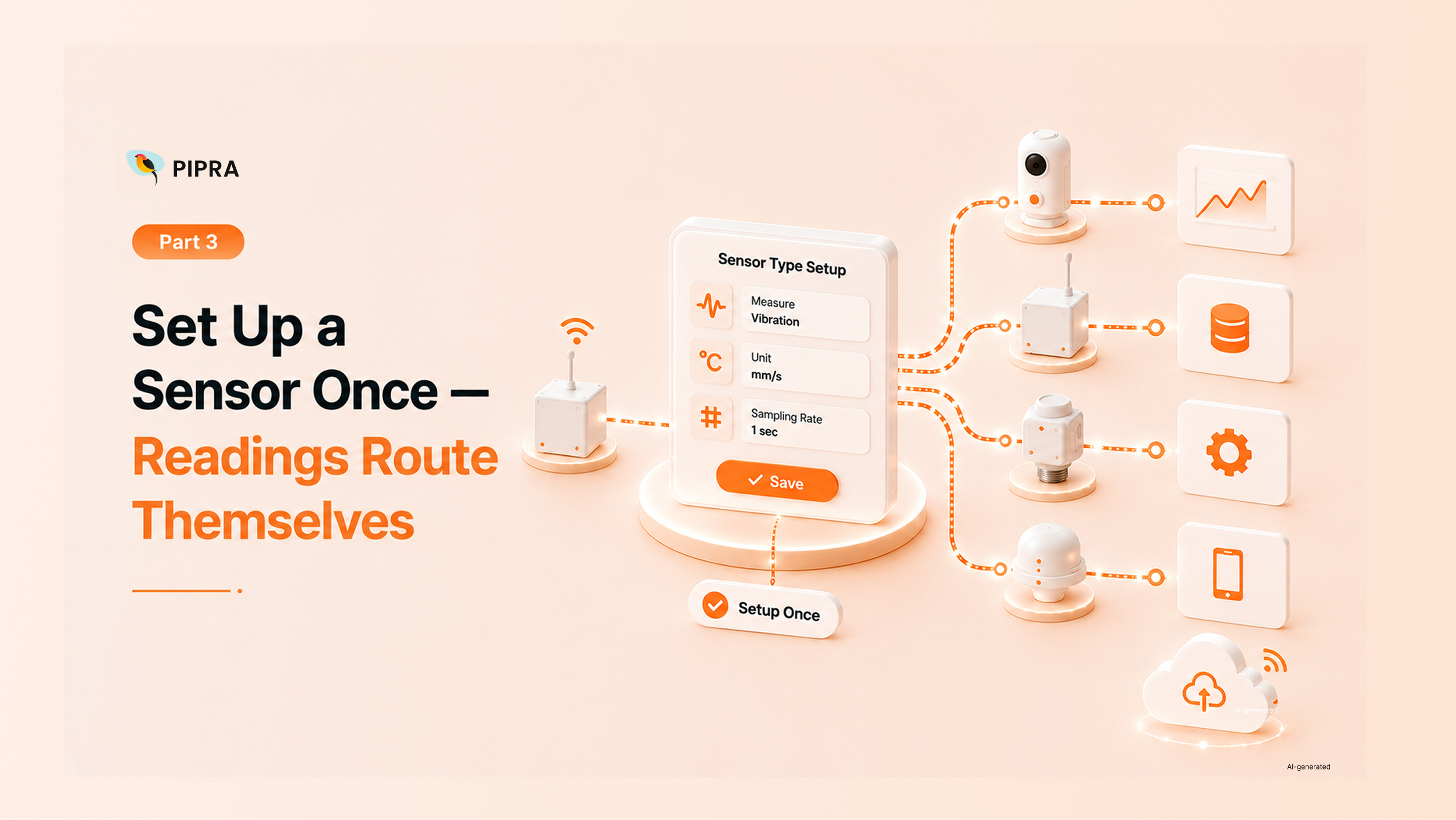
Next in the series: Part 3 - Set Up a Sensor Once, Its Readings Find Their Own Way From There.