
Modern maintenance organizations are surrounded by systems, dashboards, sensors, work orders and reports, yet many still struggle to answer a simple operational question: Are we ready?
This article explores why traditional maintenance management is becoming insufficient in environments where asset availability, spare readiness, configuration, safety, physical-world events and operational risk are increasingly interconnected. It introduces the idea of a new MRO operating model—one that moves beyond recording maintenance activity toward continuously understanding the condition, constraints and readiness of operations. The article sets the stage for a series exploring how organizations can progressively modernize MRO without replacing everything they already have.
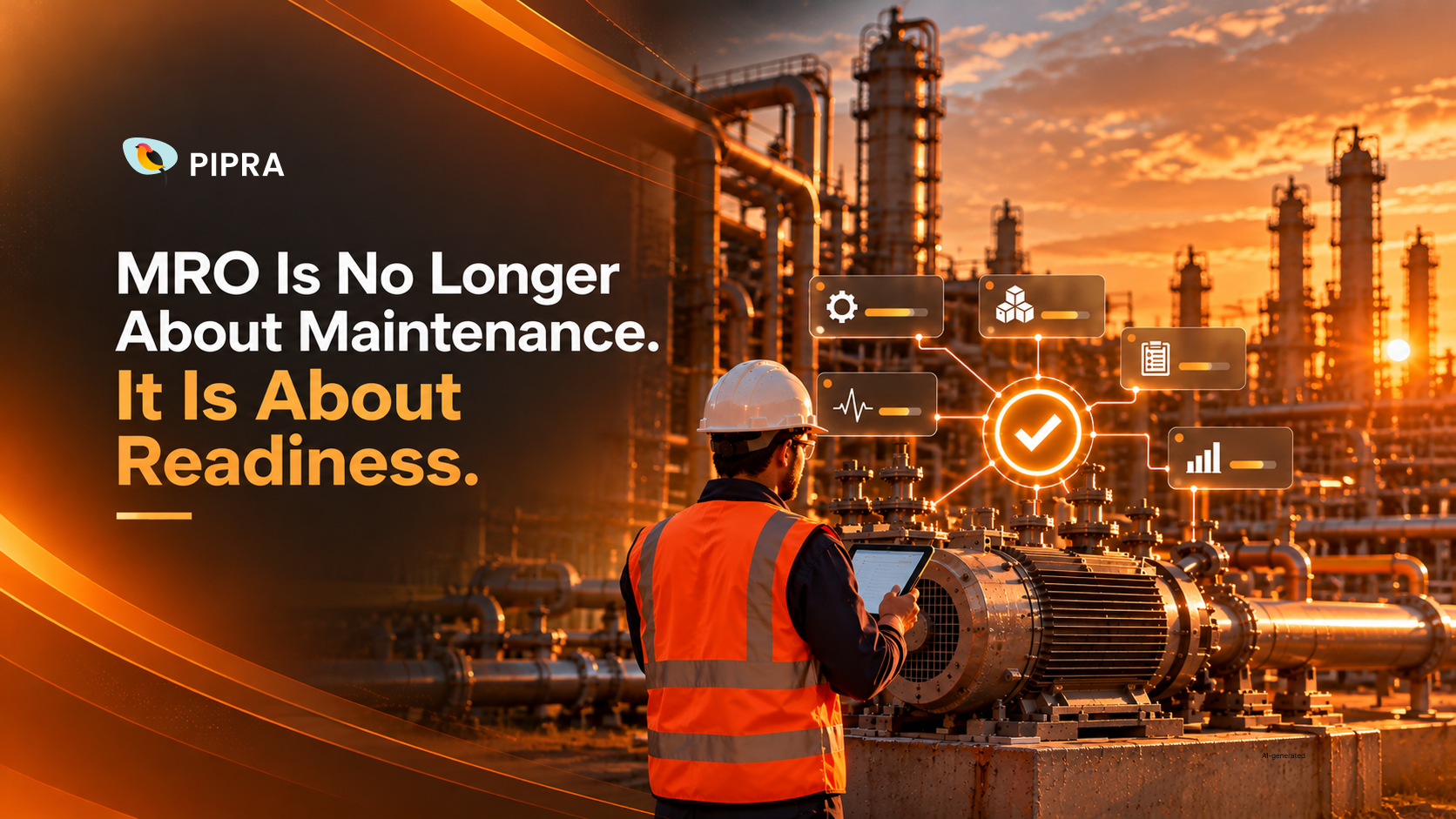
Maintenance has traditionally been measured by what gets repaired, how quickly it gets repaired and whether scheduled maintenance gets completed. But increasingly, the question that matters to operations is much simpler: Are we ready?
And yet the operation may still not be ready.
A component may be awaiting inspection. A maintenance action may have been completed but not released. A critical spare may physically exist but be unavailable for use. An unresolved condition may have been detected by a sensor. The current configuration of an asset may be different from what the operational team assumes.
Individually, each piece of information may exist somewhere.
The challenge is understanding what all of it means together.
That is why the next evolution of Maintenance, Repair and Overhaul (MRO) is not simply about digitizing maintenance.
It is about operational readiness.
Most organizations today are no longer managing maintenance entirely through paper.
They may have an ERP, EAM, CMMS, asset-management application, spreadsheets, IoT dashboards or specialist maintenance systems.
These systems have brought enormous improvements.
Organizations can create work orders, schedule preventive maintenance, manage asset masters, record failures, track inventory, assign technicians and produce reports.
But digitizing individual processes does not automatically create an integrated operational picture.
Consider a maintenance leader walking into the plant at the beginning of the day.
The questions that matter are rarely:
The questions are more likely to be:
Answering these questions often requires information from several systems—and sometimes from several people.
That is where the real MRO problem is shifting.
It is no longer merely a problem of recording maintenance activity.
It is increasingly a problem of understanding operational context.
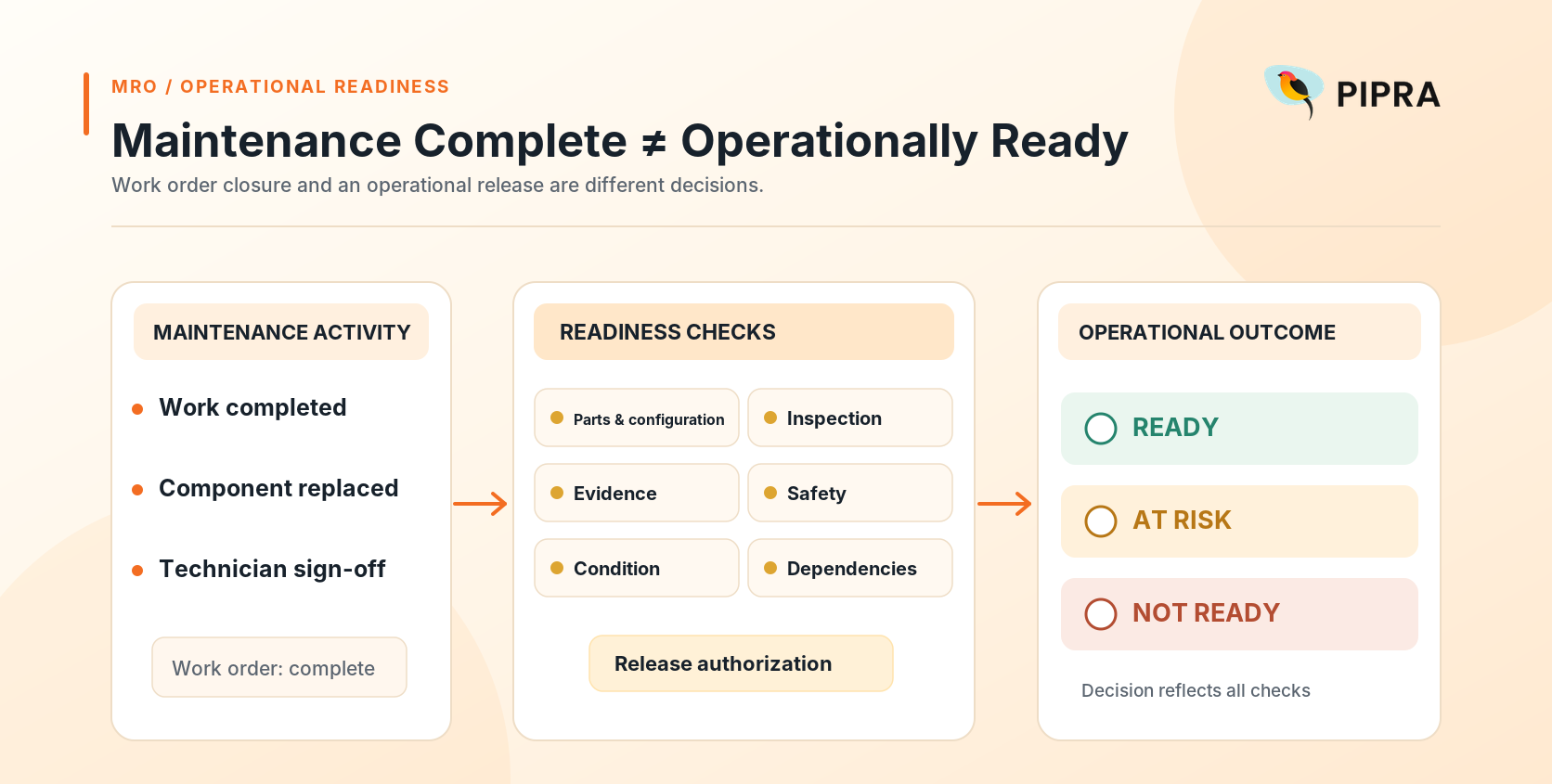
One of the most important distinctions in modern MRO is the difference between maintenance completion and operational readiness.
Imagine a critical pump has failed.
The maintenance team diagnoses the problem and replaces a component. The technician completes the work. From the perspective of the work order, the maintenance activity may be finished.
But several questions may still remain.
A transactional maintenance system can legitimately say:
Work complete.
Operations may still need to know:
Can we safely depend on this equipment now?
That gap between completion and confidence is becoming increasingly important.
Once readiness becomes the objective, maintenance stops being an isolated departmental process.
Several worlds begin to converge.
Individually, none of these ideas is new.
The opportunity comes from bringing them together so that maintenance information supports operational decisions.
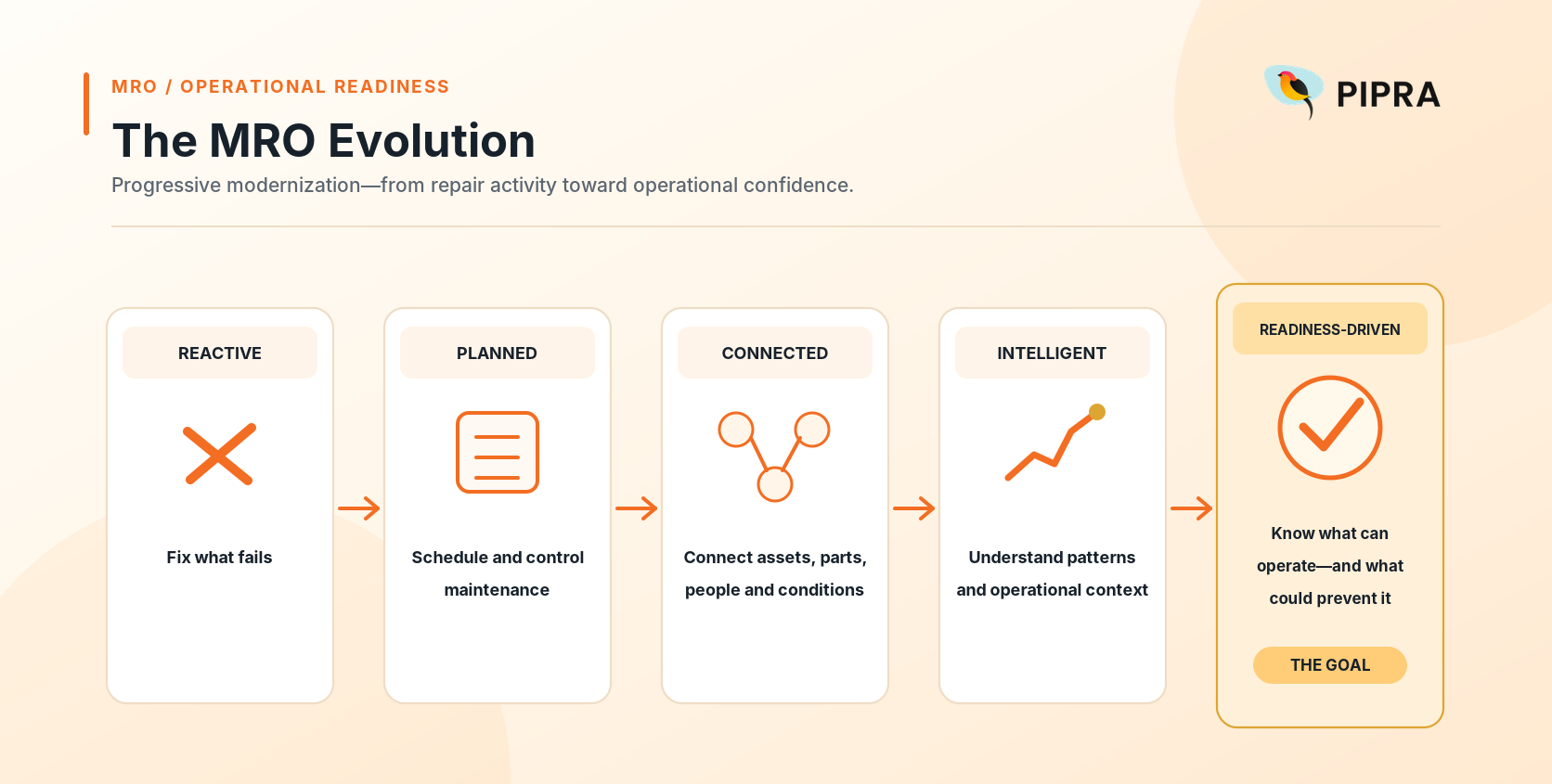
That is the transition from maintenance management toward readiness-driven MRO.
Maintenance systems have traditionally been very good at answering questions about the past:
These remain important questions.
But operational leaders increasingly need another category of questions:
The difference is subtle but significant.
The first set of questions describes maintenance history.
The second helps determine operational readiness.
An advanced MRO environment must increasingly support both.
There is another major change underway.
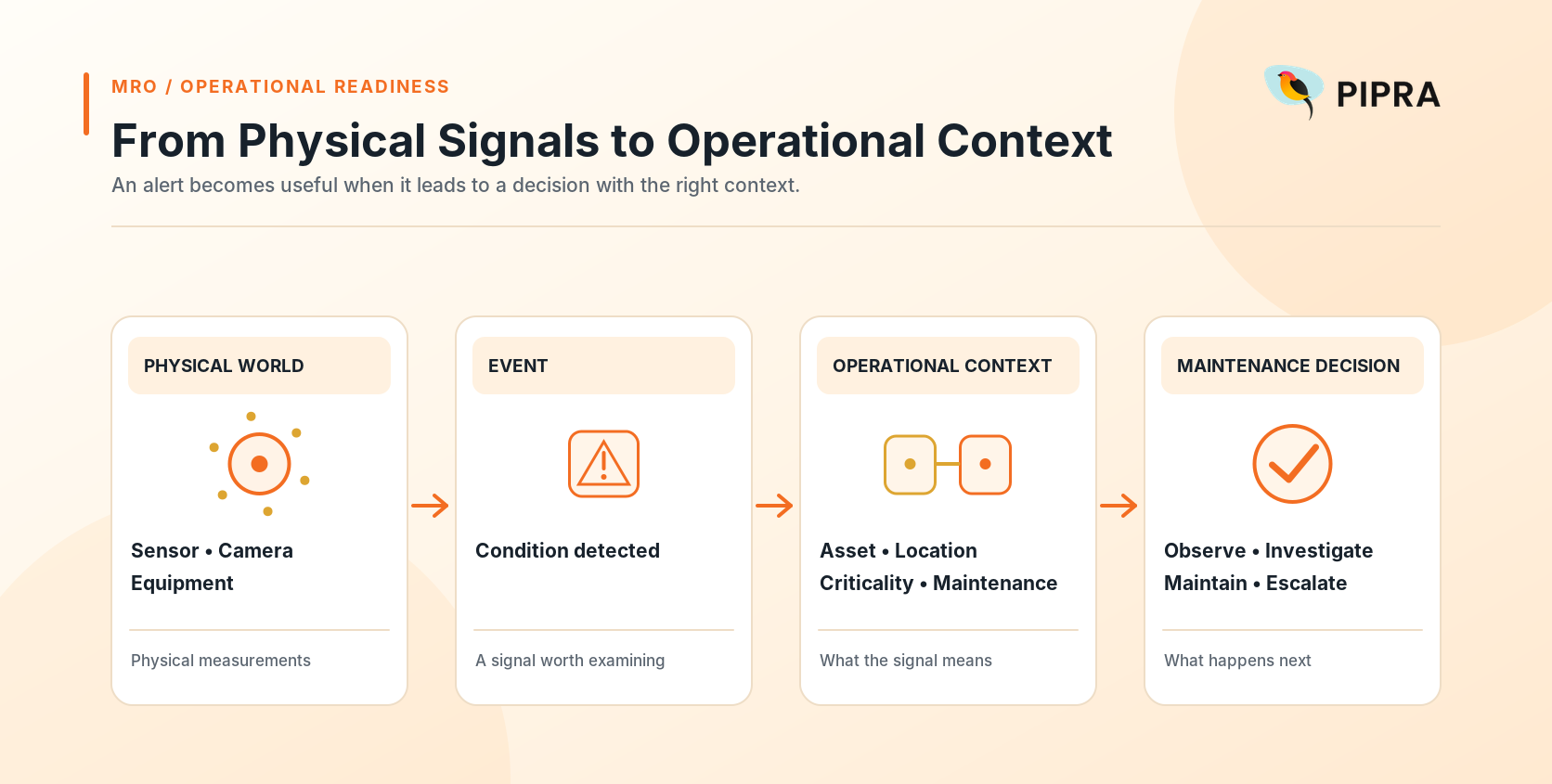
Machines are increasingly capable of communicating what is happening around them.
But producing more alerts does not necessarily improve maintenance.
An alarm saying that a temperature threshold has been exceeded is only the beginning.
Maintenance needs context.
The future of MRO will therefore not simply involve connecting more devices.
It will involve turning physical-world signals into meaningful operational context.
For decades, an asset record was primarily a structured collection of information.
Asset number. Type. Manufacturer. Installation date. Location. Maintenance schedule.
Increasingly, organizations need something richer.
They need to understand an asset in its current operational context.
This creates an interesting shift.
The asset is no longer merely something we maintain.
It becomes an evolving operational entity whose history, configuration, condition and readiness all matter.
This is also where technologies such as digital twins begin to have practical MRO value—not because a three-dimensional representation looks impressive, but because spatial and operational context can help people understand complex environments faster.
The value of a digital representation should therefore not be judged by its graphics.
It should be judged by the decisions it helps people make.
No discussion about the future of enterprise software is complete today without AI.
But maintenance is an area where enthusiasm should be balanced with control.
AI can potentially help maintenance teams search years of technical knowledge, summarize equipment histories, identify recurring patterns, interpret large volumes of information and assist technicians in troubleshooting.
That can be extremely valuable.
But there is an important distinction between:
and
In safety-sensitive or operationally critical environments, human authority, evidence and governance remain essential.
The more interesting future is therefore not autonomous maintenance replacing people.
It is maintenance professionals operating with significantly better context, intelligence and decision support.
Not necessarily.
And for many organizations, that would be the wrong starting point.
Enterprise systems often contain years of carefully built processes, integrations and master data.
The objective should not automatically be to discard these investments.
A more pragmatic question is:
What additional operational capabilities are required to move from maintenance transactions toward readiness?
MRO modernization can therefore be progressive.
The destination may be highly connected.
The journey does not have to begin with a rip-and-replace programme.
Forget the software for a moment.
Imagine asking your maintenance and operations team these questions at 8:00 tomorrow morning:
How quickly could the organization answer?
Seconds? Minutes? Hours?
Or would someone need to check several applications, open a spreadsheet, call stores, speak to maintenance, confirm something with inspection and ask an experienced employee who “knows the equipment”?
That answer may tell you more about your MRO maturity than the number of software systems you currently operate.
At PIPRA Solutions, our work around Pi MRO has increasingly been shaped by this broader question:
How can maintenance information become operational readiness rather than another collection of transactions, reports and dashboards?
There is no single answer.
It involves maintenance execution, assets, repairable components, inventory, operational context, physical-world signals, governance, digital representations, analytics and increasingly AI.
Over the coming articles in this series, we will explore these areas one by one.
We will look at questions such as:
The goal is not to add another layer of technology for its own sake.
The goal is much simpler:
When operations ask, “Are we ready?”, the organization should be able to answer with confidence.
A useful starting point is not a software demonstration.
It is understanding where you are today.
Consider:
Can your organization determine the readiness of critical assets quickly and confidently?
If the answer requires significant manual reconciliation across systems, teams and spreadsheets, there may be an opportunity to rethink how maintenance information supports operational decisions.
PIPRA Solutions works with organizations exploring the transition from traditional maintenance management toward connected, readiness-driven MRO.
Talk to us about an MRO & Operational Readiness Assessment.