
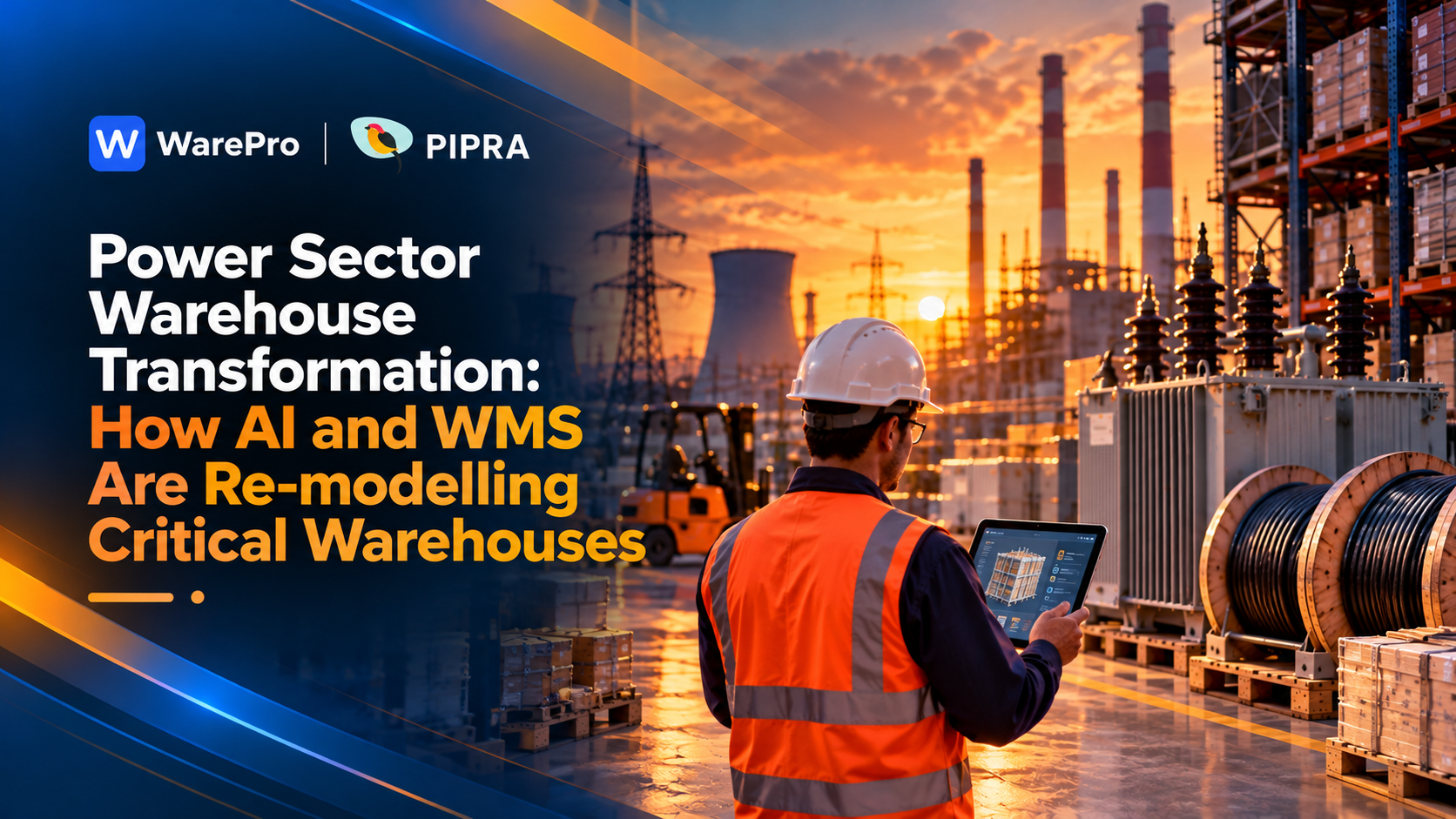
Power-sector warehouses hold high-value, mission-critical and often extremely heavy assets, where a missing or wrongly located item can extend an outage. This article explores how AI, IoT, computer vision and modern WMS can turn the warehouse into an intelligent operational layer connected to maintenance, procurement and asset health.
Power-sector warehouses operate very differently from conventional commercial warehouses. They hold high-value, mission-critical and often extremely heavy assets: transformers, motors, switchgear, cables, bearings, valves, pumps, turbine components, protection equipment, electrical spares and specialised maintenance materials. A missing or wrongly located item can delay a maintenance activity, extend an outage or affect generation and grid reliability.
The next challenge is therefore not simply to store more material. It is to make the warehouse more visible, searchable, predictive and connected to plant maintenance and operations. AI, IoT, computer vision and modern warehouse management systems (WMS) can change the warehouse from a passive storage area into an intelligent operational layer connecting inventory, maintenance, procurement, asset health and field execution.
Power utilities and generation companies maintain large inventories because equipment availability has a direct relationship with operational continuity. At the same time, holding every possible spare creates significant working-capital pressure. The warehouse must balance readiness against cost while handling materials with very different dimensions, storage requirements, criticality and shelf-life characteristics.
The challenge becomes more complex because warehouse data is often distributed across ERP, SAP transactions, maintenance systems, spreadsheets, stores registers, equipment histories and supplier records. Critical information may exist, but not necessarily in a form that allows engineers and stores teams to make a decision quickly.
The implication is important: the power-sector warehouse cannot remain a passive repository of materials.
It must become an active part of the operational decision-making process.
When equipment condition, maintenance requirements and material availability are connected, the warehouse can move from responding to requests to anticipating what the plant may need next. In a conventional power plant, maintenance systems, warehouse systems and plant operations often operate as separate information silos. AI can change this relationship by connecting equipment-health signals with maintenance requirements and material availability.
A conventional WMS answers questions such as what is in stock, where it is located and when it was issued. The next generation should help answer a more important operational question: what does the inventory position mean for plant readiness?
For example, an equipment-health system may indicate a developing issue in a critical pump. A connected WMS can immediately check whether the required spare is available, whether it is reserved for another job, where it is physically stored, whether a compatible alternative exists and whether another plant has surplus stock. The maintenance team can then act before the situation becomes an unplanned outage.
The result is a continuous loop:
Another example can be: if AI identifies an abnormal vibration or temperature pattern in a critical pump, motor or turbine component, the system can flag a potential maintenance requirement. The WMS can then immediately determine whether the required spare is available, where it is stored, whether it is already reserved for another asset and how quickly it can be issued.
This creates a continuous operational loop:
The value is therefore not limited to warehouse efficiency. The warehouse becomes part of the plant's maintenance and reliability strategy.
Power warehouses need to distinguish between ordinary inventory and inventory whose absence can affect plant availability. AI can combine historical consumption, equipment criticality, failure history, maintenance schedules, lead times and current stock to help identify which materials require higher service levels.
Instead of applying the same reorder logic to every SKU, the system can classify materials according to criticality, demand behaviour and operational consequence. A critical bearing, relay, pump component or protection device may deserve a very different stocking policy from a routinely consumed item.
An AI-enabled WMS can therefore support decisions such as:
Power-sector warehouses should not operate independently from maintenance. Planned shutdowns, preventive maintenance, corrective work orders and equipment inspections create future material requirements that can often be anticipated.
By connecting WMS data with ERP and maintenance-management information, AI can translate maintenance plans into inventory requirements. If a turbine overhaul, transformer maintenance programme or annual plant shutdown is approaching, the system can check required materials, current availability, reserved stock, procurement status and supplier lead times.
The objective is to move from ‘material requested after the problem occurs’ toward ‘material readiness before the maintenance window’.
This is particularly important when a missing component can extend an outage or delay recommissioning.
Traditional warehouse automation often focuses on fast picking and high transaction volumes. Power warehouses require a broader definition of execution because many materials are heavy, oversized, hazardous, high-value or difficult to move.
A modern WMS can standardise receiving, inspection, identification, location assignment, issue, return, transfer, reservation and cycle counting. For power-sector environments, these workflows can be extended to capture equipment-specific attributes such as serial number, rating, manufacturer, model, compatible equipment, condition, test status and storage requirements.
Where appropriate, IoT devices, barcode/RFID, handheld terminals, cameras, weigh scales, location sensors and equipment interfaces can create a digital record of physical movement. This is especially useful for cable drums, large electrical equipment, rotating-machine spares and maintenance kits.
For power-sector warehouses, AI can take this a step further by introducing the concept of maintenance-linked inventory intelligence. Not every spare has the same operational importance.
A low-cost component may be readily replaceable, while the absence of a particular transformer component, breaker, turbine part or specialized bearing could extend equipment downtime significantly.
AI can therefore help classify inventory according to factors such as asset criticality, failure probability, historical consumption, lead time, supplier availability and maintenance schedules. The WMS can use these signals to identify critical spares that should be protected from unnecessary consumption, recommend replenishment before minimum levels are reached and highlight materials that may become bottlenecks for planned or unplanned maintenance.
The physical environment of a power warehouse provides another layer of information. Sensors can monitor temperature, humidity and other environmental conditions where storage requirements demand it. Cameras can support security, access monitoring, asset identification and selected inspection use cases.
Computer vision can also help identify whether a designated storage location is occupied, detect movement of selected assets or support visual verification during receiving and dispatch. For large yards, outdoor stores and cable-storage areas, location and environmental sensing can provide additional operational visibility.
The important principle is that sensor data should not remain isolated in a dashboard. A warehouse alert becomes more valuable when it is linked to an inventory item, location, maintenance requirement or responsible team.
Generative AI can make complex warehouse and maintenance information easier for engineers, stores managers and maintenance planners to use. Instead of searching multiple systems manually, users could ask questions such as:
Generative AI introduces another layer of intelligence. A plant engineer or maintenance manager could ask a natural-language question such as:
“Is the spare required for Pump P-204 available, where is it located and when was the last replacement?”
Instead of searching across separate ERP, WMS, maintenance and equipment records, an AI assistant could bring the relevant information together and present it in an operational context.
The same approach can help teams search maintenance histories, equipment manuals, inspection records, previous failure patterns and warehouse transactions. In this model, Generative AI does not replace the WMS or maintenance system. It becomes an intelligence layer over trusted operational data, helping engineers and warehouse teams reach decisions faster while maintaining human approval for critical actions.
The future power warehouse is not simply a digitally recorded store room. It is a predictive layer between asset management and physical operations. The real transformation occurs when these systems begin working together.
Plant sensors and operational systems provide signals about equipment conditions. AI interprets those signals and identifies potential risks or maintenance requirements. The maintenance system converts those insights into work priorities, while the WMS determines whether the required materials are available and coordinates their movement.
The resulting architecture can be viewed as:
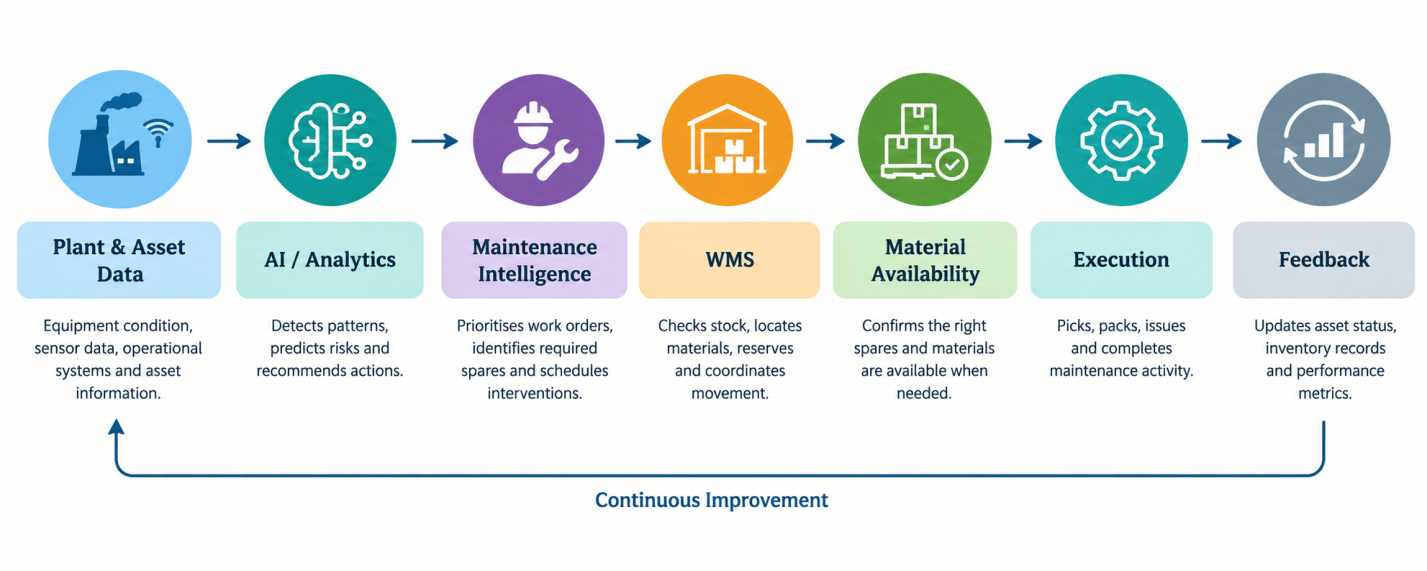
This closed-loop model can help power companies move from reactive spare-parts management toward predictive and risk-based operations. It also creates a foundation for progressively introducing digital twins, AI-assisted root-cause analysis and more advanced decision automation as data quality and organisational maturity improve.
The human role does not disappear. Engineers, maintenance planners and stores teams remain responsible for engineering judgement and operational approval. AI reduces the time spent searching, reconciling and analysing information so that people can focus on exceptions and decisions.
For power-sector organisations, the practical starting point is a reliable digital warehouse foundation rather than an attempt to create a completely autonomous stores operation on day one. WarePro by PIPRA can be positioned as the WMS layer connecting warehouse transactions with inventory visibility, enterprise integrations, IoT capabilities and operational intelligence.
A progressive implementation can follow six steps:
The technology required to create intelligent power warehouses already exists. Modern WMS platforms can digitize store operations. IoT sensors can provide continuous physical visibility. Computer vision can convert selected warehouse activity into machine-readable information. AI can analyse inventory, maintenance and equipment data. Generative AI can make technical and operational knowledge easier to access.
The challenge is no longer whether these technologies exist. It is how intelligently they are combined around the operating priorities of the power sector.
That is the direction in which power-sector warehouse transformation is heading.
Power-sector warehouse transformation does not have to begin with a complete automation programme. Start with the material and warehouse processes where better visibility, integration and intelligence can create measurable value.
Talk to PIPRA Solutions to explore how WarePro can help connect your warehouse, inventory, ERP, maintenance and IoT initiatives into a smarter power-sector operating environment.