
FMCG companies operate in an environment where demand changes quickly, product portfolios are expanding, margins remain under pressure, and customers increasingly expect products to be available exactly when and where they need them. Traditional spreadsheets, disconnected systems and manual warehouse processes make it difficult to respond at the speed modern supply chains require.
The next challenge is not simply to move products faster. It is to make the entire operation more visible, more predictive and more responsive. AI, machine learning, IoT and warehouse automation are changing this equation. The opportunity is no longer simply to automate individual warehouse tasks, but to connect forecasting, inventory, procurement, warehouse execution, logistics and decision-making into a more intelligent operating environment.
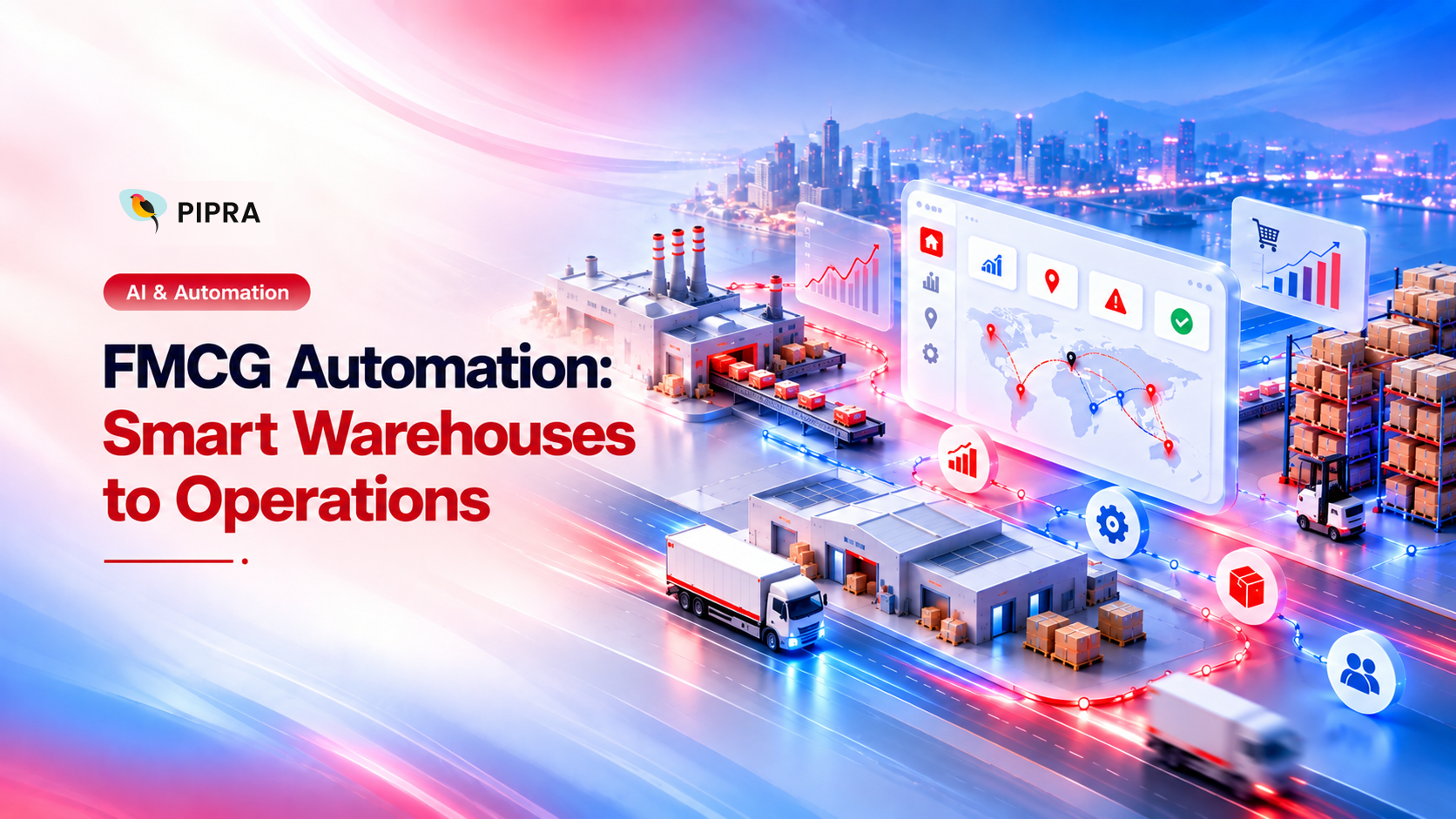
FMCG supply chains have always generated enormous amounts of operational data: sales transactions, purchase orders, inventory movements, production schedules, batch information, expiry dates, transportation data and customer orders. FMCG businesses operate on volume, availability and speed. A product that is unavailable when a customer wants it represents a lost opportunity, while excess inventory can tie up working capital and increase the risk of aging, expiry or obsolescence.
At the same time, consumer products companies are under pressure to improve productivity while continuing to invest in growth. Deloitte's 2025 Consumer Products Industry Outlook found that 96% of surveyed executives considered improving productivity a priority, while 68% said their companies were investing in smart technology and automation to transform and optimize operating costs.
The operational challenge therefore looks something like this:
McKinsey’s research on consumer companies shows that AI and automation can fundamentally change how planning and operational work is performed. Tasks that can take weeks of analysis can potentially be reduced to hours when AI, predictive forecasting and automated inventory management are integrated into workflows.
For FMCG businesses, this creates a shift from digitizing individual activities to intelligently connecting the entire operation. This is why automation in FMCG should not be viewed as simply replacing manual tasks. The larger opportunity is to connect decisions, physical operations and data into one continuous flow.
Demand forecasting is one of the most important starting points for FMCG automation because an inaccurate forecast affects almost everything downstream.
Traditional forecasting often depends heavily on historical sales and manual adjustments. AI and machine-learning models can incorporate a much broader set of variables, including promotions, seasonality, regional demand, weather, holidays, point-of-sale information and other external signals.
McKinsey has documented examples where autonomous planning improved SKU-level forecast accuracy by 10–12%, reduced finished-goods inventory by 6–8% and increased order fill rates by 3–5%. In broader CPG research, companies implementing autonomous planning have achieved inventory reductions of up to 20% and supply-chain cost reductions of up to 10%.
The objective is not simply a better forecast. It is to connect the forecast to the decisions that follow:
When these decisions are connected, forecasting becomes an operational capability rather than another spreadsheet exercise.
Inventory is one of the biggest working-capital challenges for FMCG companies. Too little stock creates stockouts and lost sales. Too much stock locks up capital and increases the risk of ageing, expiry, markdowns and waste. The challenge becomes even more complex when companies manage thousands of SKUs across multiple warehouses and distribution points.
AI can help move inventory management from static reorder rules toward continuously updated recommendations based on demand, stock position, lead times and operational conditions. McKinsey’s research indicates that advanced autonomous planning can reduce inventory by 10–20% while maintaining required service levels.
For FMCG warehouses, this intelligence can be combined with real-time WMS information to provide visibility into:
The result is a warehouse that does not merely record inventory but helps determine what should happen next.
Forecasting tells an organization what is likely to happen. A WMS and automation layer helps execute the resulting decisions. Modern FMCG warehouses need to coordinate receiving, inspection, put-away, storage, replenishment, picking, packing, consolidation, dispatch and returns. Manual coordination across these activities creates delays and makes performance highly dependent on individual operators.
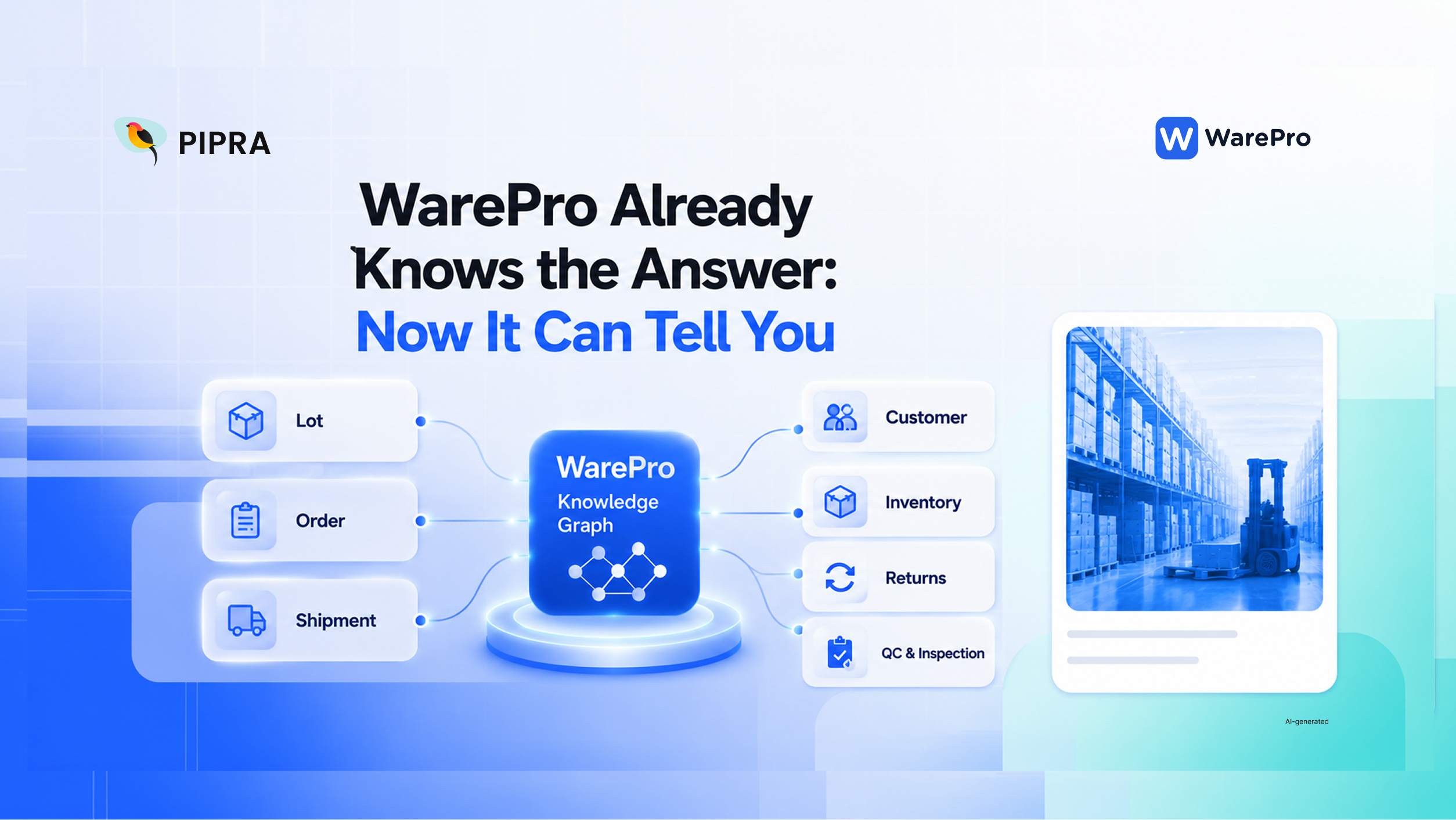
A modern WMS can automate and standardize these workflows while providing real-time visibility. For example, WarePro by PIPRA can support capabilities including automated receiving, put-away, batch and wave picking, inventory tracking, replenishment, cross-docking, serial and batch tracking, returns, consolidation and ERP integration.
This is particularly valuable for FMCG because warehouse execution must account for factors that are less critical in many other industries:
Automation therefore needs to understand the business rules of FMCG, not simply automate clicks.
FMCG automation becomes significantly more powerful when software is connected to the physical environment. IoT sensors can continuously monitor conditions such as temperature and humidity, while cameras and edge devices can provide additional operational intelligence. Instead of waiting for a manual inspection or end-of-day report, managers can receive alerts when conditions move outside acceptable thresholds.
This is especially important for food, beverages, pharmaceuticals, cosmetics and other products where environmental conditions can affect product quality. PIPRA’s WarePro ecosystem already supports IoT-based monitoring for warehouse environments, including temperature and humidity sensing, as well as camera-based capabilities for detecting unauthorized access and other operational events.
The broader opportunity is to connect these signals directly to warehouse workflows.
For example:
This is fundamentally different from simply storing sensor readings in a dashboard.
The warehouse does not operate in isolation. Once an order leaves the warehouse, FMCG companies must coordinate transportation, distributors, retailers, 3PLs and customers. Delays or errors outside the warehouse can still undermine an otherwise efficient fulfillment operation. AI-enabled supply-chain systems can help organizations monitor inventory, transportation and fulfillment together rather than treating each activity as a separate process.
McKinsey research on AI in distribution identifies potential improvements including 20–30% lower inventory, 5–20% lower logistics costs and 5–15% lower procurement spend in appropriate use cases.
For FMCG companies, this can translate into better coordination of:
The key is integration. A logistics alert becomes much more useful when the system can immediately determine which customer order, SKU, warehouse and inventory position are affected.
Traditional automation usually follows predefined rules: If X happens THEN perform Y. This works well for stable, repetitive processes. However, FMCG operations are full of exceptions. Demand changes, suppliers delay shipments, promotions create unexpected spikes, products approach expiry, vehicles are delayed and inventory moves between locations.
McKinsey’s work on autonomous supply-chain planning highlights this shift toward continuous planning, where AI and analytics connect demand signals with inventory, production, procurement and logistics decisions.
The human role does not disappear. Instead, teams can spend less time performing repetitive coordination and more time handling exceptions, commercial decisions and strategic planning.
Automation projects should begin with business outcomes rather than technology checklists. A useful FMCG automation program should establish measurable baselines and then track improvement across areas such as inventory, warehouse productivity, order fulfillment and service levels.
McKinsey's research shows that AI-enabled supply-chain planning can improve forecast accuracy and inventory performance, while Deloitte's consumer-products research shows that productivity and efficiency are major drivers of technology investment.
Typical KPI categories include:
The exact improvement will depend on the starting point, process design, product characteristics and implementation quality. Automation should therefore be measured against the company's own baseline rather than against generic promises.
Dashboards are useful, but visibility alone does not create transformation. The next stage is moving toward a loop of sensing, understanding, recommending, executing, and learning.
This is where AI becomes particularly interesting. A system could identify a potential stockout, determine the affected SKU and location, assess replenishment options and present the recommended action to the responsible team. In more mature environments, selected decisions may eventually be executed automatically within defined business rules, while exceptions remain with human decision-makers.
Deloitte's 2026 Consumer Products Industry Outlook indicates that AI investment is accelerating and that productivity is the leading expected outcome of AI investment among CPG companies. Its research also points toward growing interest in AI agents and autonomous systems. But there is an important caveat: AI cannot compensate for poor operational data.
The intelligent warehouse starts with a reliable digital foundation. Deloitte’s research reinforces that the value of AI adoption depends not only on technology but also on organizational capability, skills and the ability to scale new ways of working.
For many FMCG companies, the most practical starting point is not a complete “lights-out” warehouse. It is building a reliable digital foundation. WarePro by PIPRA is designed as a warehouse management platform that connects core warehouse processes with real-time inventory visibility, automation, integrations, IoT capabilities and advanced operational intelligence.
This allows organizations to approach automation progressively:
This approach reduces the risk of attempting a massive transformation project before the underlying operational data and processes are ready.
The technology required to create intelligent FMCG operations already exists. AI is becoming increasingly embedded in consumer-products strategies. IoT sensors are increasingly affordable. Computer vision can convert physical activity into machine-readable information. Modern WMS platforms can connect warehouse execution with the wider enterprise.
The challenge is no longer whether these technologies exist. It is how intelligently they are combined.
Deloitte's 2026 research describes a consumer-products sector where AI ambition is high but execution and scaling remain important challenges. For FMCG companies, the answer may therefore not be another isolated technology project. It may be a connected operational architecture in which the warehouse becomes the bridge between demand, inventory, people, physical assets and intelligent decision-making.
That is the direction in which FMCG automation is heading.
FMCG automation does not have to begin with a complete transformation. Start with the operational processes where better visibility, automation and intelligence can create measurable value.
Talk to PIPRA Solutions to explore how WarePro can help connect your warehouse, inventory, IoT and automation initiatives into a smarter FMCG operating environment.