

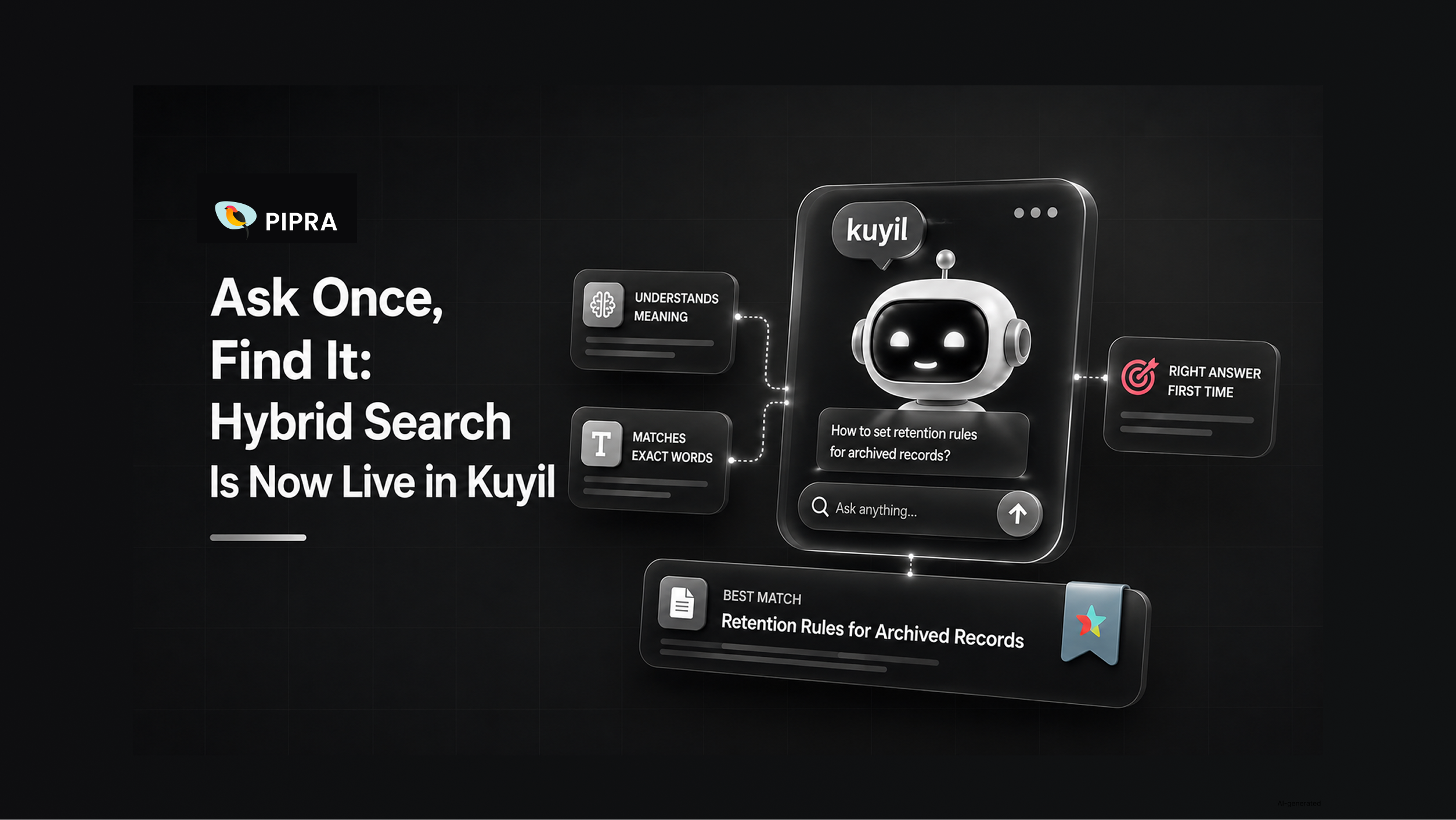
Kuyil is PIPRA Solutions' AI platform for company knowledge bases. A business connects it to the content it already maintains, such as product documentation, FAQs, policies and procedure manuals. Customers then ask questions in plain language and get answers drawn from that content alone, not from the open internet. Every answer depends on one thing going right first: finding the document that holds it.
Retrieval is exactly where most systems struggle, because search engines understand a question in one of two ways. Meaning-based search grasps intent, so it surfaces articles that are conceptually close to the question even when the wording differs. Keyword search does the opposite: it finds every article containing the customer's exact terms, whatever those articles are actually about.
Each approach fails in its own way. Meaning-based search returns material that is nearly right, articles in the same neighbourhood as the answer that never quite land on it. Keyword search returns precise matches scattered across unrelated documents, with no sense of which one the customer needs.
The documentation itself is rarely the problem. Teams write accurate articles and keep them current. What fails is the step between a well-phrased question and a well-written answer, and customers experience that failure as "the knowledge base doesn't have it".
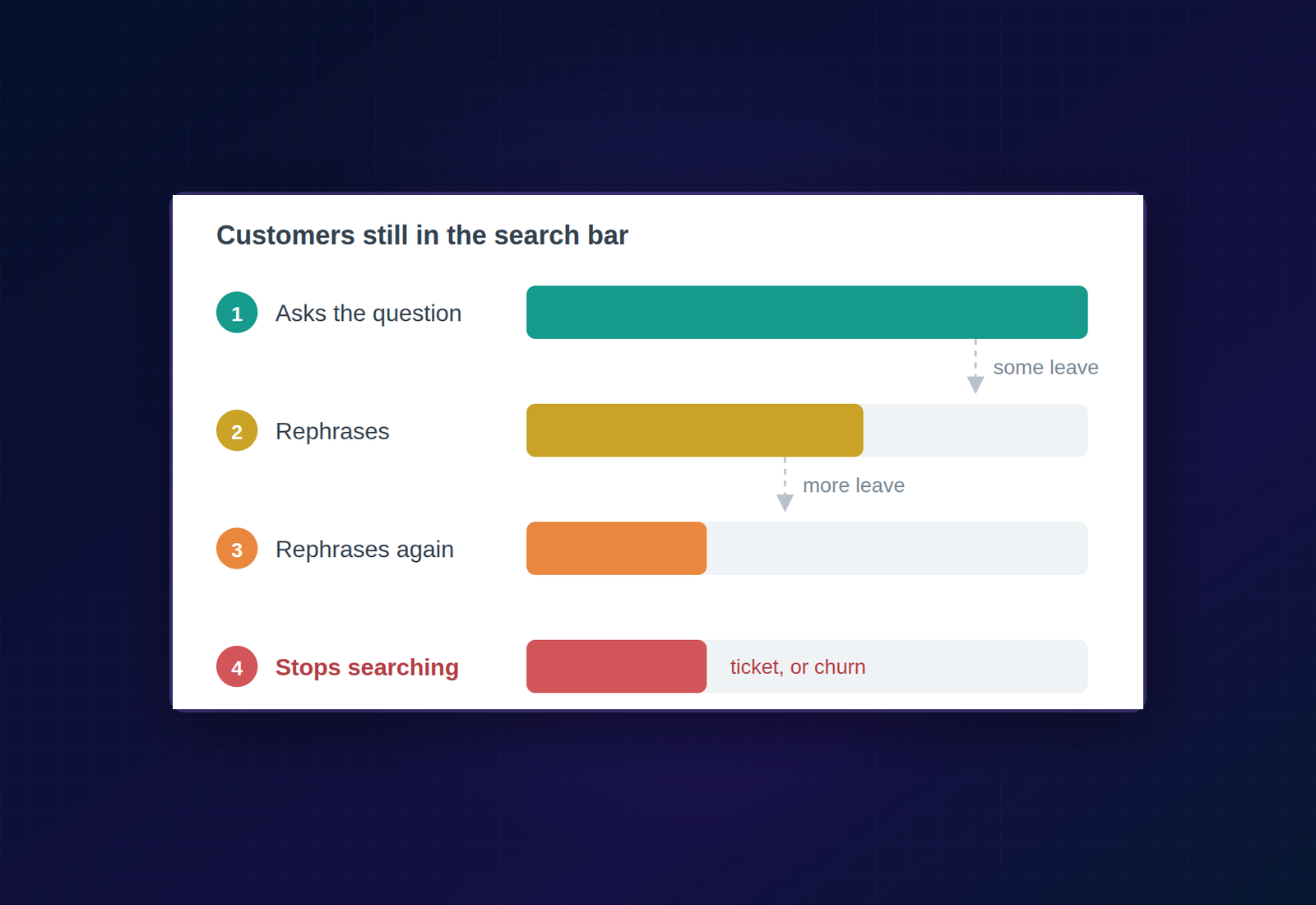
Picture the current experience from the customer's side. They ask a question in their own words. The results look relevant but none of them answers it, so they try again with different words, and then again. Each attempt is a guess about how your documentation happens to be phrased, and after five or six guesses most people stop guessing.
Some of them email support and wait for a human to find the article the search engine could not. The rest quietly conclude that your product is hard to use.
Hybrid search removes the choice between meaning and precision. When a customer asks a question, Kuyil weighs every candidate answer on both counts at once: how well it matches the intent behind the question, and how well it matches the actual words in it. Documents that satisfy both rise to the top.

Consider a customer asking how to set retention rules for archived records. Meaning-only search returns general material about archiving and data lifecycle policy, close in concept but silent on retention rules. Keyword-only search returns every page that mentions "retention", including several that have nothing to do with archives. Hybrid search returns the configuration guide that covers retention rules in the context of archiving, because that document is strong on both counts. The customer asks once and moves on.
The goal is a first search that returns the answer, however the customer chooses to phrase the question. In production use, hybrid search routinely retrieves the documents that meaning-only search leaves buried.
No two archives behave the same. A support FAQ leans on exact phrases, because customers quote error messages and feature names. A conceptual product guide leans the other way, since readers describe goals rather than terminology. Kuyil lets each customer's retrieval behaviour be adjusted to suit their content, with no code changes and no redeployment. Search adapts to the archive it serves instead of forcing every archive into one setting.
Questions rarely arrive in the language a document was written in, and archives that serve customers in several languages usually pay for it with worse search. Hybrid search closes that gap: a question asked in one language can surface the right document even when the wording, or the language itself, differs. Multilingual knowledge bases work for every customer through the same search bar.
The value shows up in day-to-day operations rather than in the search technology itself.
Customers who find the answer on the first search never open a ticket. Your team spends its time on questions the documentation genuinely does not cover.
New users ask in natural language and self-serve from day one, instead of hunting through folders or waiting on colleagues.
Retrieval no longer depends on guessing the right phrasing, so every customer gets the same quality of answer.
When the first search works, people come back and search again. A knowledge base that answers reliably becomes the default place to look.
Documentation only grows, and expectations for search are now set by consumer products that answer on the first try. That gap between expectation and experience widens every year an archive keeps expanding.

Across all of them, the mechanism is the same: better retrieval turns an archive people avoid into one they rely on.
Underneath hybrid search sits a general idea: respect both what a question means and the words it uses, and let both signals decide what comes back. Only the content changes between a legal archive, a support desk and a product manual.
Retrieval also sits underneath every knowledge-heavy workflow you might build next. Improve it once, and self-serve support, onboarding and assisted answering all improve with it.
Kuyil's hybrid search is available for demonstration from PIPRA Solutions. If you want to see a walkthrough of how it reads a question for both its meaning and its exact wording, adapts its retrieval to each knowledge base, and answers customers in whichever language they ask, we would be glad to connect. Reach out to PIPRA Solutions to see what it looks like in practice.