
WarePro is a warehouse management platform covering the full lifecycle: receiving and quality control, storage and putaway, inventory counts, sales and purchase orders, packaging and labelling, shipping, returns and expiry. Scanners capture what moves, so counts stay right without anyone tallying them by hand. Where cold chain matters, sensors watch temperature and moisture against the rules for each product. Door activity and vehicle movement are monitored as well, and the day lands in one dashboard instead of six reports.
Which means the warehouse ends up holding an unusually complete record of itself.
Ask WarePro for a stock level or the QC history on a batch and the answer comes back at once. That is a question about one record, and warehouse systems are built to answer it.
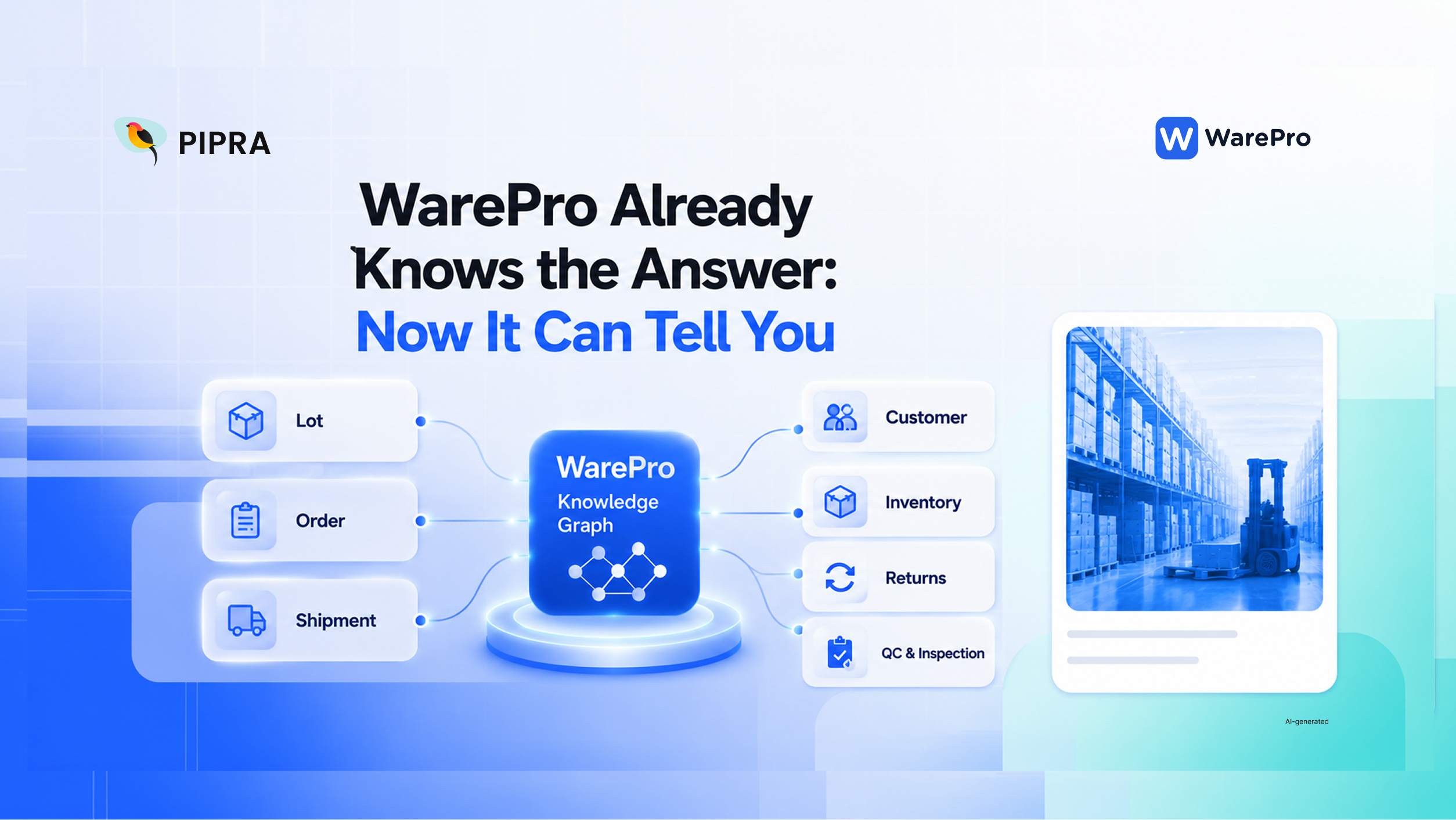
Trouble starts when a question spans several records: which open orders depend on a part that just went short, which customers received goods from a lot now in doubt, who signs off on a purchase while the usual approver is on leave. Those answers exist too. They are stored as ID numbers pointing at other ID numbers, a structure designed to keep data safe rather than to explain it.
So the work falls to a person. Someone who knows the system writes a query. Anyone who doesn't, makes an educated guess and hopes the guess was conservative. With a recall clock running or a customer waiting on the line, neither is a good place to be.
The pattern is familiar in most operations teams. A question comes in from the floor, from a customer, or from finance, and it goes to whoever knows the system best. That person exports a few reports, lines them up in a spreadsheet, cross-references by hand, and comes back a day later with something defensible. By then stock has moved and the answer describes yesterday.
Nobody in that chain is doing bad work. Manual effort just doesn't scale with the number of parts, orders and customers a growing business carries.
A warehouse knowledge graph treats relationships as facts in their own right. This lot went into that shipment, what was left on that order, for that customer, from that warehouse. Those connections are recorded and kept, so nothing has to be reassembled by hand every time a question arrives.
That one change turns a warehouse system from a place you file things into a system you can question. Think about how a person works through a recall: lot, batch, shipment, customer, one link at a time. The graph holds the chain the same way, which is why the answer comes back in the shape the question was asked.
It also keeps up. As orders ship, stock moves and receipts land through the day, the graph stays current on its own, with no overnight rebuild and no drag on the operations running underneath.
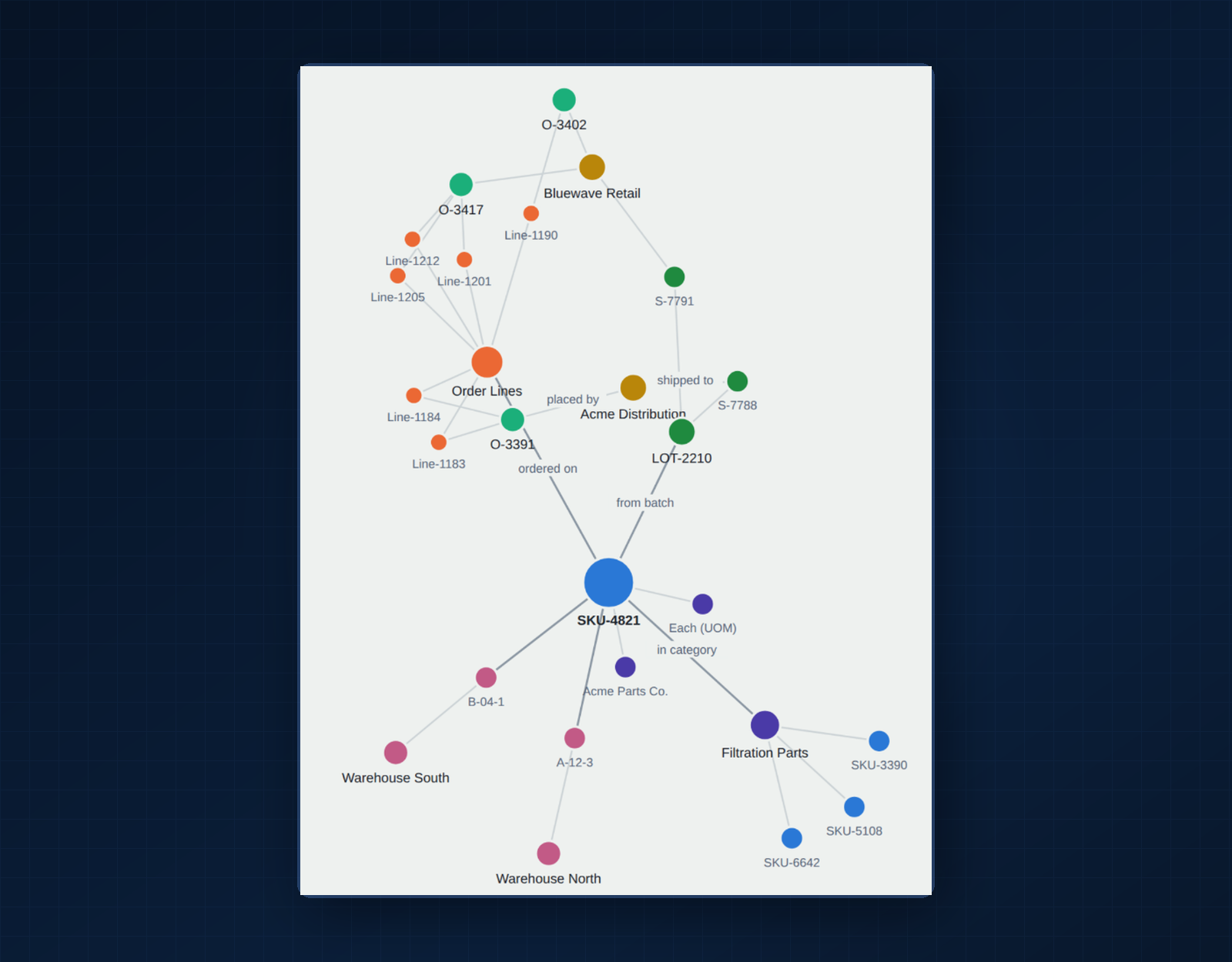
The graph lives inside the WarePro chat assistant your team already opens, and that is the part people feel. Someone types "which shipments were affected by lot 2026-A", or asks who reports into a given supervisor, and the answer arrives in seconds with the records behind it.
Results come back as readable tables. Where the question suits it, a trace renders as a timeline and a comparison renders as a chart, so a supervisor can see the shape of a problem without exporting anything into a spreadsheet first. Every answer also carries the moment its underlying data was last refreshed, which matters more than it sounds. An answer you can date is an answer you can defend.
Speed is worth very little if the answer is wrong, so the assistant is bounded on purpose.
It reads. Nothing it does can alter a record or move stock, which means no version of a badly worded question damages the business.
In a group running several tenants or business units, one company's data never appears in another company's answers. That separation is structural, not a rule somebody has to remember at the moment of asking. The graph also checks its own work, comparing itself against the source records on a schedule and surfacing drift before it turns into a surprise during an audit. And every question, every answer and the time it took gets written to a log you can open inside WarePro, so a conversation with the assistant is as reviewable as any other transaction on the system.
Judge the impact by what changes on the warehouse floor, not by the technology behind it.
Order profiles keep getting more varied while delivery promises get shorter, and regulators keep tightening what has to be traceable. The teams fielding the questions are not growing at anything like the same rate. That gap is where a warehouse knowledge graph earns its place.
The earlier a relationship becomes visible, the cheaper the decision that follows it.
None of this asks you to replace the system running the warehouse today. The graph adds a layer of meaning over data you already own, and the same approach retargets to manufacturing or field service, where the questions rhyme and only the records underneath them change.
The WarePro chat assistant and its knowledge graph are available for demonstration from PIPRA Solutions. If you want to see a lot traced to its affected shipments in seconds, answers that carry their own timestamp and audit trail, and tenant data kept separate by construction, we would be glad to connect. Reach out to PIPRA Solutions to see what it looks like in practice.