

Good fulfilment decisions depend on one thing: clarity before action, knowing with confidence whether you can meet an order before you commit to it.
In most ERPs that clarity is expensive to produce. The data is all there (stock levels, order history, vendor records), but turning it into a decision is manual work that's easy to rush when the queue is long.
The challenge is operational, and it's easy to misread. Your people don't lack skill. The work is experience-dependent and doesn't scale: judgment lives in someone's head, steps get shortcut under pressure, and oversights slip through exactly when volume is highest.
When a decision turns out wrong, the cost lands downstream in expedited freight and lost orders, and in the eroded trust of a customer you promised a date you couldn't hit.
Picture the typical flow.
An order arrives. A planner opens it and starts cross-referencing, checking stock for each line item and trying to recall whether demand for those parts has been rising. One item turns out to be discontinued, so the hunt for a substitute begins. For anything short, the planner pulls up vendor records, weighs price against lead time, factors in who has actually delivered on time before, and drafts a purchase order. Then it goes out for approval, with follow-ups when it stalls.

Done carefully, this is good work. The trouble is that "carefully" doesn't survive contact with volume.
The concrete risks stack up fast:
Now imagine the order arriving and the investigation simply happening.

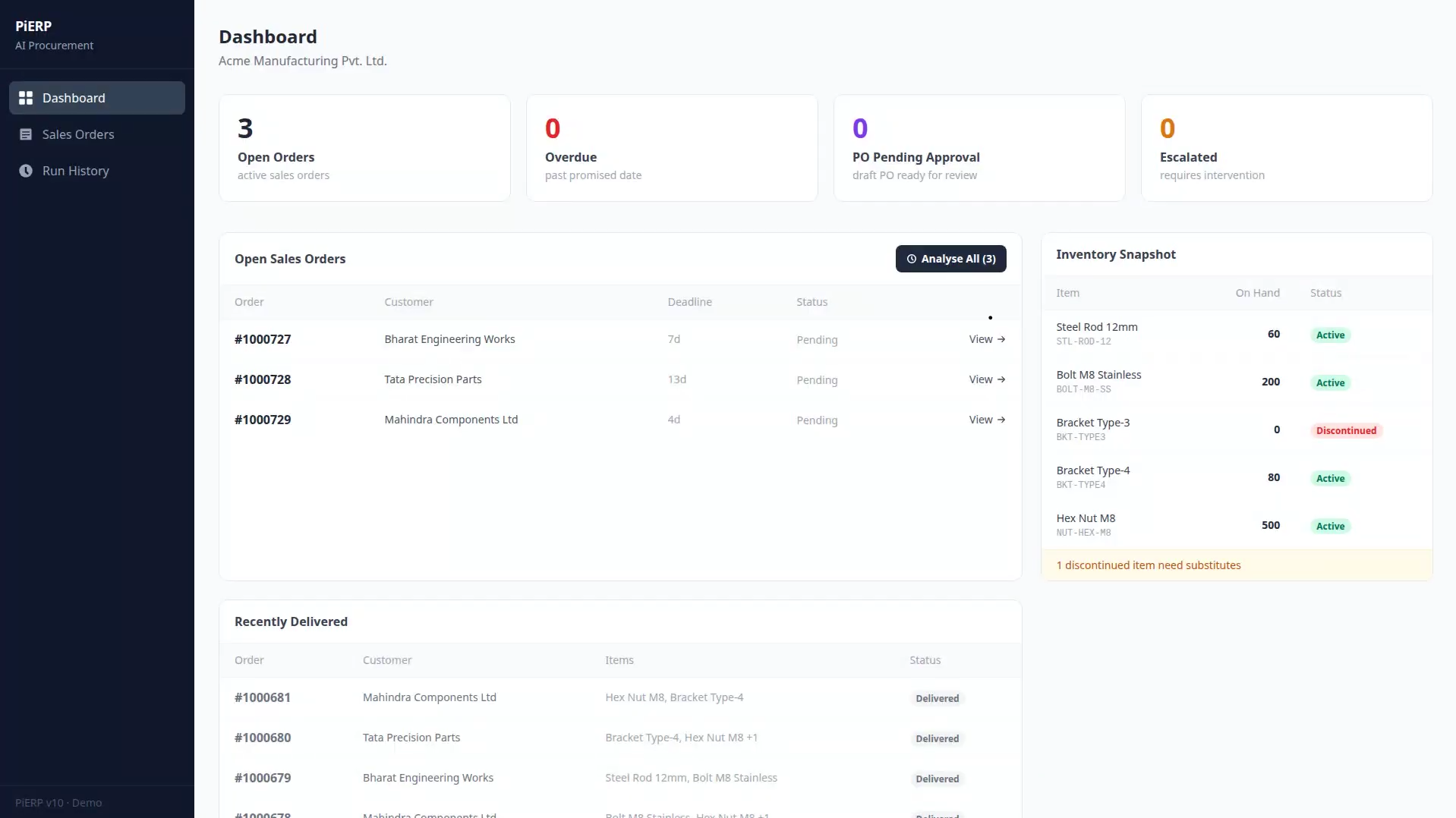
PIPRA's proof-of-concept runs a four-agent pipeline on live ERP data, in sequence: Inventory, Demand, Procurement, Notification. The first agent reads real stock-on-hand. Demand forecasting comes next, sizing the procurement quantity from actual order history rather than gut feel. Procurement then scores vendors on price, lead time, and proven on-time reliability, swaps in alternates for discontinued items, and drafts the purchase order. Notification closes the loop, packaging everything for one-click human approval.
The full reasoning streams live, every step visible, and the operator holds a kill switch throughout.
The goal is simple: hand the manager a reasoned, ready-to-approve decision instead of a pile of raw data to sift through. The planner stops asking "what do I think is true?" and starts reviewing what the data shows alongside a recommendation and its reasoning.
What matters here is the operational outcome: faster and steadier decisions that are easier to defend.
Investigation that once took a planner twenty minutes now happens in moments, so the queue moves and commitments are made sooner.
Every recommendation arrives with its reasoning attached, so managers see the reasoning, not only the result, and can approve or push back with confidence.
Catching shortfalls and discontinued items up front means fewer fire drills and fewer reversed orders, with less expedited freight downstream.
Inventory, demand, and procurement logic run as one connected flow instead of three manual steps passed between people.
Knowing you can fulfil before you promise means the dates you give hold, and that reliability compounds into trust.
The obvious worry is whether this replaces the planner. It doesn't, because the system removes the legwork so the planner can focus on the part that actually needs a person: judgment.
Your people bring context the system doesn't have, like the strategic customer you'd flex inventory for, the supplier relationship worth protecting, or the order that breaks the usual pattern. The AI brings speed and consistency, recognising patterns across far more data than any person can hold at once.
Neither is enough alone. A human without the analysis is slow and overloaded; analysis without human judgment is brittle and blind to context.
Together they make a stronger model. The AI runs the investigation and shows its reasoning, and the human stays firmly in control, approving or rejecting with feedback. When a manager rejects a draft PO with a constraint, say a lower maximum quantity or a different vendor, the agent re-plans in a single round. The expert sets the direction; the system does the running.
Fulfilment is getting harder, not easier. Product variants are multiplying, custom orders are rising, and customers expect faster delivery with less tolerance for slippage. The manual approach that just about coped last year is quietly buckling under this year's complexity.
The agents handle the situations where that complexity bites:
The thread running through all of them: a better understanding of each order produces a better outcome from it.
Competitiveness, increasingly, comes down to one thing: how fast and how accurately a business turns information into action.
The data has always been in your ERP. What's changed is the ability to act on it autonomously, at the speed orders actually arrive, without giving up the human judgment that keeps decisions sound.
That's what agentic AI for ERP procurement delivers. The operation isn't replaced; it simply moves faster and with more confidence, turning "an order arrived" into "here's exactly what we should do about it."
Maybe you're wondering whether agentic AI is real or just hype for a shop floor like yours. Walk through it with us and see how this might fit the way your team already works, with no commitment and just a look at what's possible.
Or book a conversation with PIPRA and watch the four-agent procurement pipeline run on live ERP data. We'll show you exactly how it investigates an order and drafts a decision your manager can approve in one click.
Imagine every sales order arriving with the fulfilment decision already made: stock checked, demand forecast, vendor scored, PO drafted, reasoning shown. Talk to PIPRA about making that your team's normal.