

Manufacturers of electric motors, gearboxes, geared motors, solar pumps, inverters, battery systems and EV powertrains manage a warehouse that is far more complex than a simple store of finished products. Incoming copper wire, laminations, magnets, bearings, shafts, gears, fasteners, castings, controllers and packaging materials must be available at the right production cell, in the right quantity, at the right time.
A shortage can stop a line. A misplaced bearing or gear can trigger hours of searching. A material issued to the wrong work order can create rework or quality risk. And when warehouse activity is recorded on paper or in spreadsheets, supervisors often discover the problem only after production has already been affected.

This is where a manufacturing-focused Warehouse Management System (WMS) such as WarePro by PIPRA Solutions can make a difference: by connecting material receipt, storage, movement, production issue, return, finished goods and dispatch into a traceable operational flow—supported by AI/ML where the data and use case justify it.
A motor or powertrain manufacturer may handle hundreds or thousands of SKUs, multiple units of measure, batch-controlled components, supplier-packed quantities, work-in-progress (WIP), and finished products with different configurations. Warehouse locations may include a central store, line-side supermarkets, tool cribs, quality-hold zones, assembly cells, packing areas and dispatch bays.
Typical problems are operational, not merely administrative:
The objective is not to scan everything endlessly. It is to create reliable transaction points, enforce the right checks, and capture material identity and quantity at the level that makes operational and financial sense.
WarePro can be configured as the execution layer between ERP/MRP, receiving, storage, production staging, shop-floor consumption and dispatch. ERP may continue to manage purchase orders, BOMs, costing and planning; WMS governs the physical warehouse transactions and feeds confirmed movements back to the enterprise system.
A typical flow looks like this:
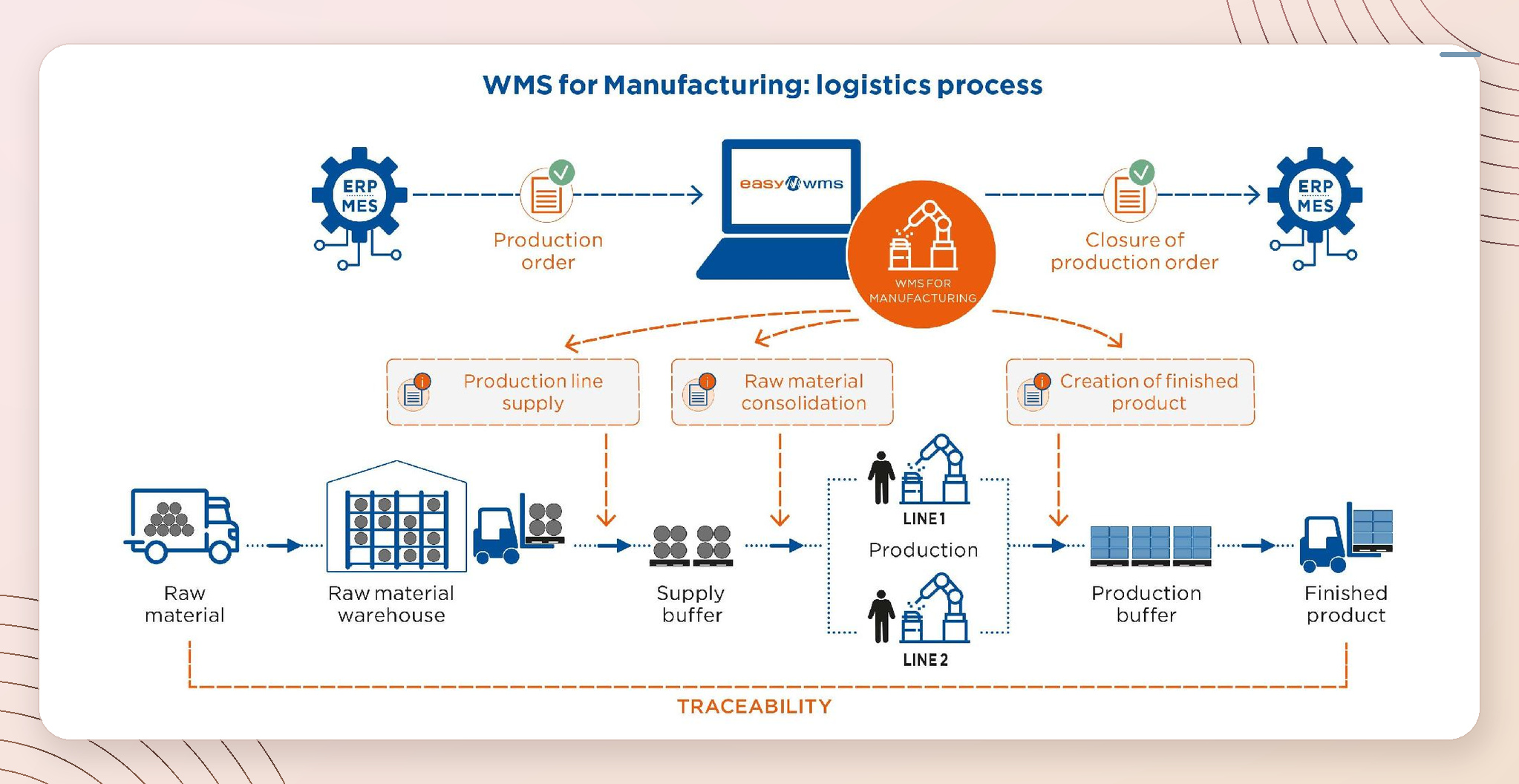
At the receiving dock, a handheld scanner or mobile device can capture a supplier label, barcode, QR code or PIPRA-generated internal label. WarePro can validate the material code, PO, supplier, expected quantity, unit of measure and receipt status. Exceptions can be wrong part, excess quantity, short receipt, damaged package or missing documentation can be routed for supervisor or quality approval rather than silently entering available stock.
Bearings, magnets, shafts, copper, electronic controllers and safety-critical parts may require inspection or test results. A WMS status such as ‘inspection pending’ or ‘quality hold’ prevents stock from being allocated to production until release. Accepted, rejected and quarantined quantities remain separately visible.
Rule-based put-away can recommend a bin based on dimensions, weight, hazard or quality status, storage conditions, movement frequency, production proximity and available capacity. AI/ML can later improve slotting recommendations by learning from pick frequency, congestion and replenishment patterns—but the system should retain hard constraints such as approved storage zones and material compatibility.
Consider gears arriving in packs of three. Scanning every individual gear at receiving is impractical when the supplier’s packaging is intact. But once the pack is opened, production may consume one gear at a time. A WMS must preserve accurate unit-level stock without forcing unnecessary scans at the dock.
A workable approach is pack-level receiving combined with controlled unit-level issue:
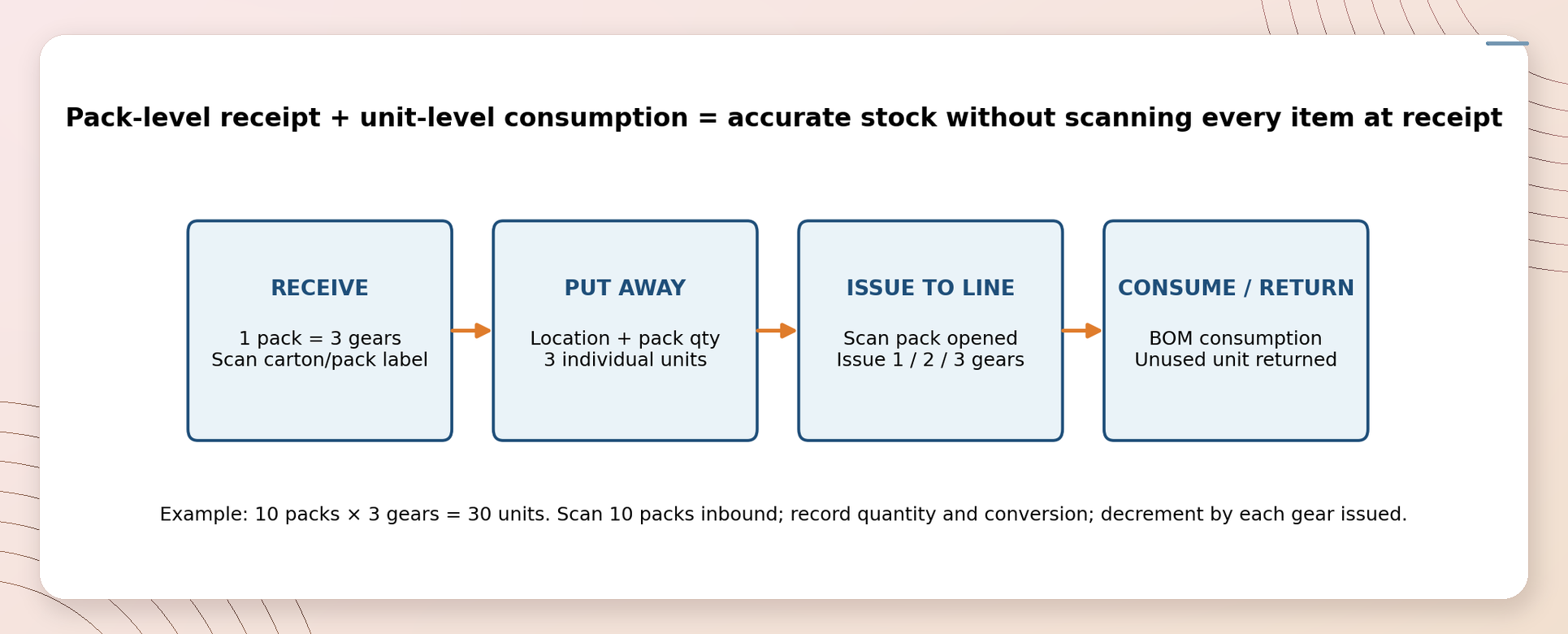
For high-risk, high-value or serialized components, unit-level serial scanning may be justified. For low-risk bulk items, pack-level or quantity-based transactions with cycle counts can be more practical. The policy should be chosen by value, traceability needs, risk and cost—not by a blanket rule.
A WMS can create task visibility for receiving, put-away, replenishment, line feeding, picking, returns and dispatch. Each task can be assigned to a worker or team, timestamped when accepted and completed, and measured against distance, priority, workload and expected service time.
This gives supervisors a factual view of operational flow:
AI/ML can analyze task history to flag unusual idle intervals, repeated delays, excessive walking, or productivity patterns that deserve investigation. It should not treat every pause as misconduct: machine downtime, blocked aisles, missing material, quality holds, authorized breaks and supervisor instructions must be included in the context.
The aim is to identify bottlenecks and improve task allocation—not to make unsupported judgments about employees. Transparent policies, worker awareness, role-based access and human review are important when using productivity analytics.
At put-away, the operator scans the item and destination bin. WarePro checks whether the bin is valid for that SKU, size, revision, batch, storage condition or material family. If the part is placed in the wrong bin, the system can reject the transaction or require an authorized override. During picking, the operator scans the source bin and item to confirm the correct material before it leaves the location.
A WMS strengthens control through transaction accountability: who moved what, from which location, to which destination, for which work order, and at what time. AI/ML can flag anomalies such as repeated unplanned issues, unusually high scrap, movements outside approved routes, frequent stock adjustments, repeated short picks, or high-value parts leaving controlled zones without a matching order.
These are exception signals and not proof of any theft. Investigation should combine transaction logs, physical counts, access controls, CCTV where lawful and appropriate, supervisor review and a documented process.
AI/ML is most valuable when it improves a clear decision or predicts an operational exception. It should be introduced after barcode discipline, location master data, BOMs, work orders and inventory transactions are sufficiently reliable.
Use consumption history, open work orders, supplier lead times, line-side stock and production schedules to identify components likely to run short. Alert planners before bearings, copper wire, gears, magnets or controller assemblies become a line-stoppage risk.
Analyze pick frequency, SKU co-occurrence, bin utilization and travel paths to recommend high-runner locations near production or dispatch. Maintain safety, weight, size and quality restrictions as non-negotiable rules.
Estimate task duration and workload by zone, then recommend assignment or batching. Detect recurring waiting and excessive travel to help supervisors improve layout, staffing or replenishment timing.
Identify abnormal issue quantities, duplicate scans, frequent adjustments, stock movement patterns, unusual scrap or repeated discrepancy locations. Escalate for human verification.
Correlate material shortage, production delay, supplier lot, location, operator task and shift patterns to identify whether recurring problems originate in receiving, quality, put-away, replenishment or production consumption.
Public case studies show that warehouse digitization is already being applied in India across retail distribution, automotive, electrical manufacturing and industrial supply chains. These are examples of reported outcomes from individual deployments—not guaranteed results for every plant or a direct WarePro promise.
Miebach reports a WMS go-live at a leading solar panel manufacturer in India, covering raw materials, packaging materials and finished goods from dock-in to dock-out. The implementation uses box-level license plate numbers (LPNs), serial-number aggregation and integration with production data to strengthen traceability from manufacturing through product installation. It supports piece-in/pallet-in and piece-out/pallet-out workflows, as well as route-based, system-directed loading. Miebach reports that the outbound setup freed capacity equivalent to 1.6 full-time employees per day, allowing the team to focus on higher-value work. This manufacturing example is more relevant than a retail warehouse: it illustrates how WarePro-style process discipline can connect component receipt, production, finished goods and dispatch. The reported capacity benefit is specific to that deployment and is not a guaranteed WarePro outcome.
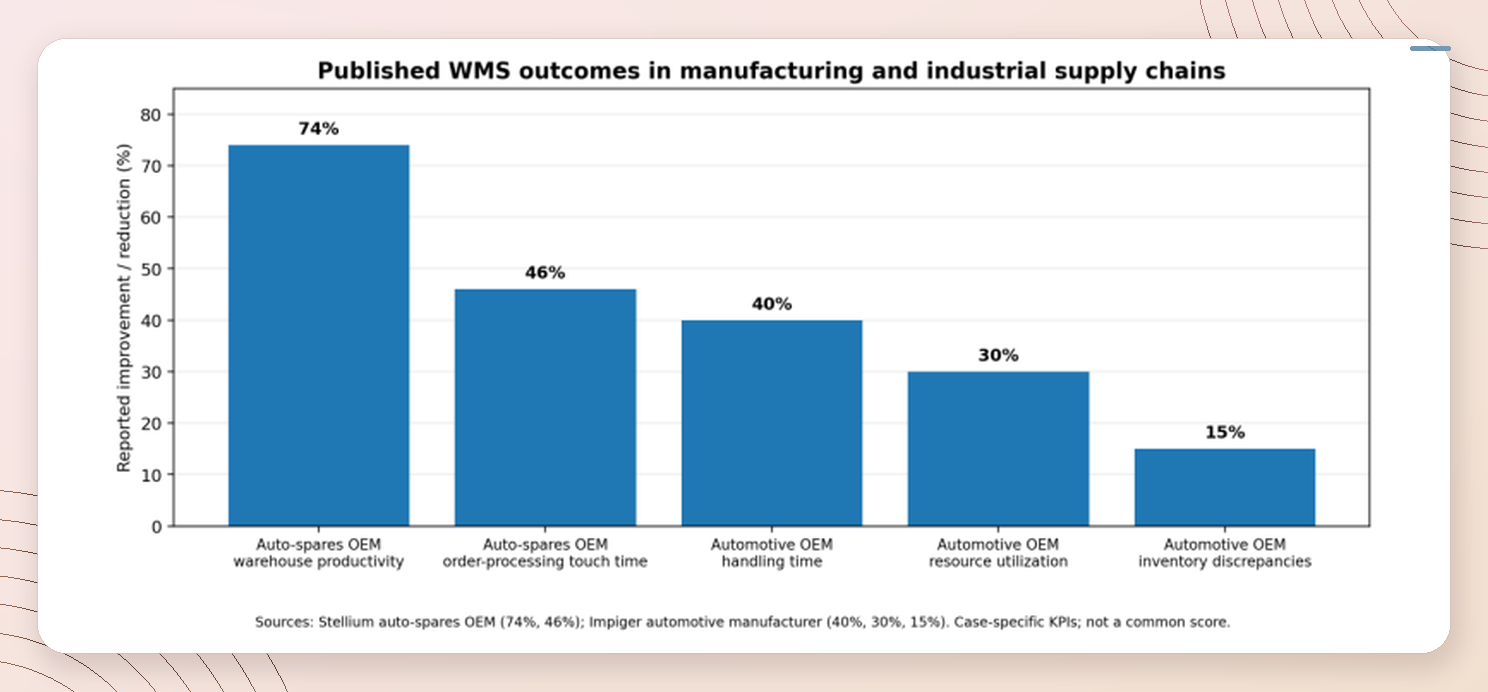
Impiger’s published case study for a leading automobile manufacturer reports a 40% reduction in inventory handling time, 30% improvement in resource utilization and 15% reduction in inventory discrepancies following WMS implementation and SAP integration. These reported results highlight the potential of digitized movement and visibility in production-linked warehouses.
A Stellium case study for an Indian auto-spares OEM describes a 1-lakh-square-foot warehouse with roughly 13,000 parts. Its reported improvement program included a 74% increase in warehouse productivity, 20% increase in inventory accuracy and 46% reduction in order-processing touch time. These are case-specific results, not a universal benchmark.
PIPRA’s published WarePro electrical manufacturing and distribution case describes a Mumbai-based manufacturer of modular switches, LED lighting and home automation products. The use cases include plant-to-distribution-center visibility, (Bill of Material-BOM)-aware put-away, line-feed optimization, ATP visibility, wave/waveless picking, cycle counts and stock variance controls. This is directly relevant to component-heavy electrical and industrial manufacturing.
The broader lesson: WMS benefits are not limited to e-commerce picking. They apply to component stores, line-side inventory, multi-plant movement, production staging and dealer or OEM dispatch.
Document receiving, quality, storage, open-pack handling, line feeding, WIP, finished goods, returns, scrap and dispatch. Establish the baseline for inventory accuracy, material search time, line shortages, pick errors and handling productivity.
Clean SKU codes, UOM conversions, pack sizes, BOMs, work orders, supplier lots, bins, storage rules and employee roles. Master-data quality is the foundation of dependable automation.
Start with receiving, put-away, production issue, returns, replenishment, finished goods receipt and dispatch. Introduce barcode or QR labels and mobile scanning where they reduce ambiguity.
Integrate purchase orders, work orders, BOM demand, production consumption and finished goods updates. Define which system owns each record and how exceptions are reconciled.
First deliver operational visibility and rule-based alerts. Then add predictive shortage, task balancing, anomaly detection and slotting models once enough clean data exists.
Run a pilot in one store, production line or product family. Compare post-implementation KPIs with the baseline, validate the results and expand only after processes are stable.
Every plant should define its own targets after measuring the current state. The following are recommended metrics—not guaranteed WarePro outcomes:
Set improvement targets from the measured baseline, SKU complexity, layout, volume, labor model and implementation scope. Published case-study percentages can inform ambition, but should never be presented as a forecast without a pilot and customer-specific validation.
For motor, gearbox, solar, energy-storage and EV manufacturers, warehouse performance directly influences production continuity, quality, working capital and customer delivery. The next step is not simply installing scanners or dashboards; it is creating a controlled digital flow of materials from supplier receipt to final dispatch.
WarePro by PIPRA can help establish that foundation through mobile warehouse execution, location and inventory control, ERP integration, task visibility, traceability and analytics. AI/ML can then build on reliable transactions to identify risks, reduce avoidable movement and support better decisions on the shop floor.
Start with one warehouse, one production line or one high-impact material family. Map the current process, measure the losses and identify where barcode workflows, WarePro visibility and AI-enabled exception management can deliver a practical improvement.
Talk to PIPRA Solutions to explore how WarePro can connect receiving, inventory, production material flow, shop-floor productivity and dispatch in a single warehouse execution environment.