
Banking has changed dramatically over the last decade.
Customers no longer compare their banking experience only with other banks. They compare it with every digital service they use e-commerce apps, ride-hailing platforms, food delivery apps, payment apps, and instant messaging tools.
They expect banking support to be fast, simple, always available, and available in the language they are most comfortable with.
But banks operate under a very different reality.
They must manage sensitive customer information, strict compliance requirements, internal security policies, auditability, and regulatory expectations. For large banks, these constraints are not optional. Any technology introduced into customer support must work within this controlled environment.
This creates a difficult question:
How can a bank deliver modern AI-powered customer support without compromising data privacy, security, or regulatory confidence?
At PIPRA Solutions, this is exactly the kind of problem we are solving with Kuyil.
Customer support in banking is complex.
A customer may want to know about account services, loan information, card processes, digital banking steps, branch details, policy questions, transaction-related processes, or product eligibility. Many of these queries are repetitive, but they still consume large amounts of support bandwidth.
At the same time, customers may communicate in different languages. In a country like India, multilingual support is not a feature—it is a necessity. Customers are more comfortable when they can ask questions and receive answers in their preferred language.
This creates pressure on banks to deliver:
Traditional customer support models struggle to meet all these needs together.
Cloud-based AI tools can offer speed and intelligence, but many banks are cautious about sending sensitive data outside their intranet or controlled environment.
On the other hand, fully manual support models offer control, but they are difficult to scale and often lead to delays, inconsistent responses, and higher operational costs.
Banks need a middle path.
The future of AI in banking is not just about smarter models. It is about trusted deployment.
For many financial institutions, the most acceptable AI solution is one that works within their own infrastructure, respects internal policies, and does not require sensitive data to move outside their environment.
This is where on-prem AI becomes highly relevant.
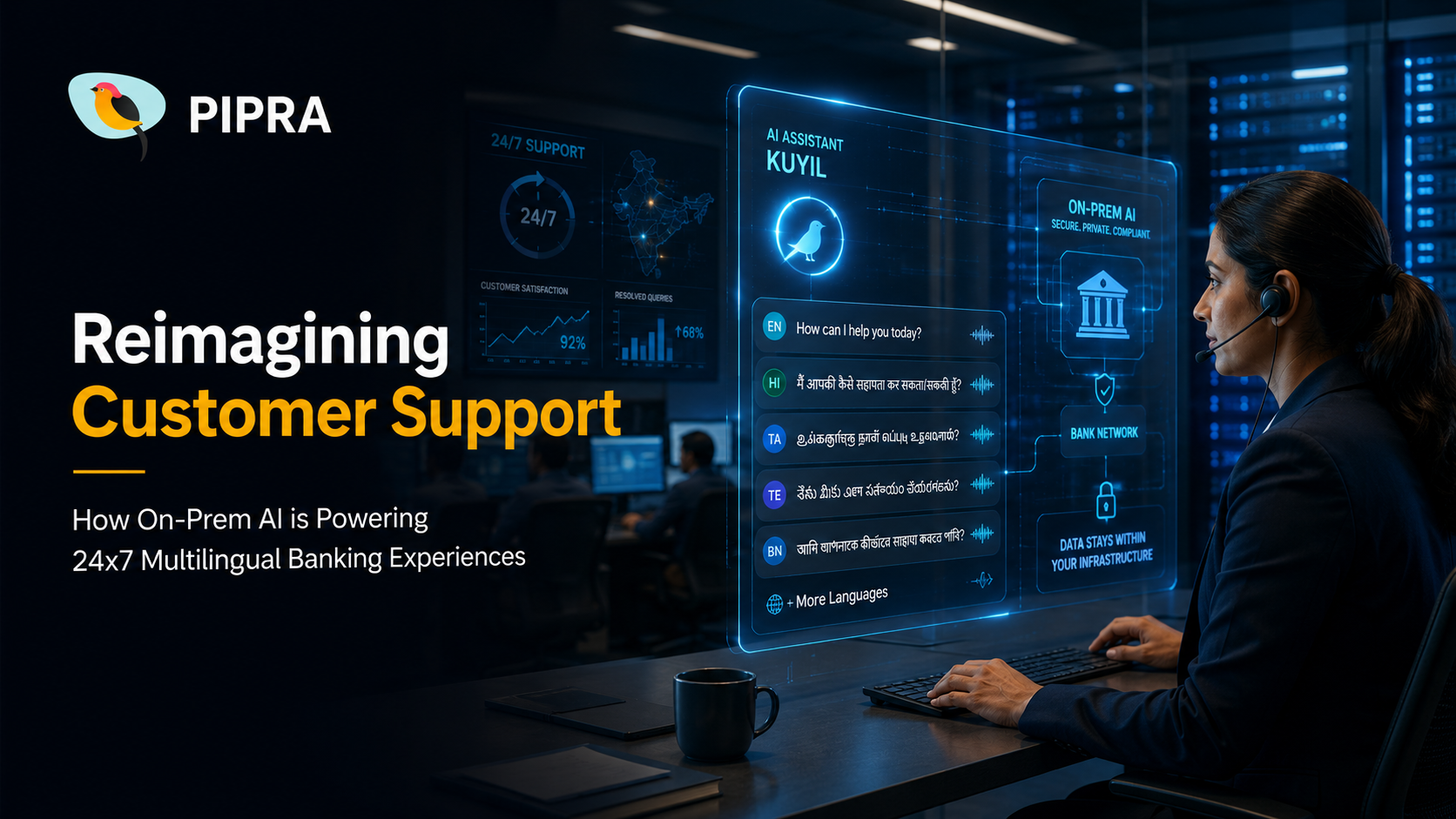
With Kuyil, PIPRA Solutions is working on a customer support approach where the AI assistant can operate within the bank’s intranet. This enables the bank to use AI for customer care while maintaining control over data, access, infrastructure, and governance.
The idea is simple:
Bring AI to the bank’s data—not the bank’s data to external AI systems.
This approach aligns well with the mindset of banks that want innovation but cannot compromise on trust.
For a bank, language is not just a communication preference. It directly impacts customer experience.
When customers are forced to interact only in English or in a limited set of supported languages, they may feel disconnected from the service. This is especially important for public-facing financial institutions that serve diverse customer groups across regions.
A multilingual AI assistant can help customers ask questions in their preferred language and receive responses in the same or another supported language.
This can improve:
For banks serving large and diverse populations, multilingual AI support can become a major differentiator.
One of the strongest business cases for AI-led customer support is availability.
Human support teams cannot scale infinitely. Adding more support hours usually means adding more staff, more shifts, more training, and more operational cost.
AI changes this model.
An AI assistant can handle routine queries at any time of the day, allowing human agents to focus on complex, sensitive, or exception-based cases.
This does not eliminate the need for human support. Instead, it improves how human support is used.
The result is a more balanced support model:
For many industries, cloud AI adoption may be straightforward. For banking, it is more nuanced.
Banks deal with:
Even when the use case appears simple, governance expectations remain high.
An on-prem AI deployment can help address many of these concerns because the system can run within the bank’s approved environment. This provides better control over where data resides, how access is managed, and how usage is monitored.
For banking leaders, this is not only a technology decision. It is a trust decision.
A well-designed AI customer support assistant can create value across multiple dimensions:
Customers receive faster responses and can interact in languages they understand.
Routine queries can be handled by the AI assistant, reducing the load on call center and support teams.
The assistant can provide standard responses based on approved content, reducing variation across agents or departments.
On-prem deployment gives the bank greater confidence over data and system governance.
Support capacity can grow without needing to scale human teams at the same rate.
In banking, AI cannot be treated as a casual experiment. It must be designed responsibly.
This means the system must be:
At PIPRA Solutions, we believe AI adoption in banking must combine innovation with institutional discipline.
That is why Kuyil is positioned not only as an AI assistant, but as a controlled conversational layer that can work within enterprise boundaries.
Building a production-grade on-prem AI assistant for banking is not a one-step process. It requires deliberate engineering choices at every layer, from the model that generates responses, to the serving infrastructure that handles concurrent users, to the context window that holds enough information to answer complex queries reliably.
Here is how our thinking evolved—and what we learned along the way.
We began with a straightforward setup: a single GPU server, a widely used model serving tool, and a capable large language model. This gave us a working prototype quickly, and we learned a great deal from early testing.
However, as usage grew, two problems became clear. First, the system could only handle one request at a time. When multiple users accessed the assistant simultaneously, wait times increased significantly. Second, the initial model consumed most of the available GPU memory, leaving little room for efficiently processing longer conversations and retrieved documents.
A banking support assistant must serve many users at once. We migrated to a high-performance inference engine designed specifically for this purpose. This engine allows multiple requests to share the GPU simultaneously, delivering consistent response times even under peak load, without requiring additional servers or proportional cost increases.
This was a foundational step. It meant Kuyil could be genuinely production-ready, not just a single-user demo.
Bigger models are not always better. For Kuyil’s core use case, answering customer queries based on retrieved bank documents and FAQs, a leaner, instruction-tuned model performed on par with much larger alternatives. The advantage was twofold: the smaller model consumed far less GPU memory, freeing up significant capacity for processing longer conversations and retrieved content, and it responded faster under load.
We also validated that the model we selected carries a fully open and permissive license, making it suitable for commercial banking deployments without licensing risk.
We explored aggressive model compression techniques to reduce memory usage further. While this did lower resource consumption, it introduced reliability problems: the compressed model struggled to follow structured output instructions consistently, and its behavior was more sensitive to prompt variations.
In a banking context, reliability is non-negotiable. An assistant that occasionally produces garbled or incorrectly formatted responses cannot be trusted by customers or compliance teams. We reverted to the full-precision model and accepted the higher memory cost as the right trade-off for consistent, dependable output.
As Kuyil’s capabilities expanded, so did the demands on context. Multi-turn banking conversations—where a customer might ask a follow-up question about a loan, then switch to a card query—require holding a meaningful amount of conversation history and retrieved document content simultaneously.
To address this, we migrated to a model with a significantly larger context window. This allows Kuyil to maintain richer, more coherent conversations across longer interactions—without losing track of earlier context or forcing unnecessary truncation of retrieved bank content. The result is a more natural, helpful customer experience, particularly for complex queries that span multiple topics or require referencing detailed policy documents.
Every architectural decision in Kuyil’s stack - the inference engine, the model choice, the precision level, and the context capacity was made with one priority in mind: building a system that a bank can actually trust and deploy with confidence.
Customer support is often the first visible touchpoint of digital transformation.
When customers experience fast, accurate, multilingual, and always-available support, they begin to trust the institution’s digital capabilities more deeply.
For banks, this is not only about answering questions. It is about improving trust, accessibility, and service quality at scale.
AI makes this possible—but only when implemented in a way that respects the realities of banking.
If your bank or financial institution is exploring AI-powered customer support but needs strong control over data, infrastructure, and compliance, PIPRA Solutions can help you evaluate an on-prem AI approach with Kuyil.
Connect with PIPRA Solutions to explore how multilingual, on-prem AI can transform customer support without compromising trust.