

Maintenance organizations often measure digital maturity by the systems they have implemented: ERP, EAM, CMMS, spreadsheets, dashboards, mobile forms, sensors and reports. A more revealing test is much simpler: can the organization answer the most important operational questions quickly, confidently and from one shared picture? This article proposes ten questions that expose whether maintenance information is truly decision-ready. They cover critical asset availability, blockers, parts, overdue work, repeat failures, configuration change, safety evidence, physical-world conditions and restoration confidence. The objective is not to promote another dashboard. It is to show that MRO maturity is ultimately about reducing the time between an operational question and a trustworthy answer. If those answers still require calls, spreadsheets and reconciliation across teams, the organization may be digitally busy but not yet readiness-driven. It also gives maintenance and operations leaders a practical way to benchmark their current state without starting with a product discussion. The questions can be used in a workshop, a daily review or a pilot-selection exercise, making the article both diagnostic and immediately actionable.
A maintenance organization can own sophisticated software and still depend heavily on human memory. The difference becomes visible when an operations leader asks a direct question: “What is stopping us from operating?” If the response begins with “Give me some time to check,” the issue is rarely the absence of data. More often, the information exists but is scattered across work orders, stores, inspection records, asset history, emails and conversations.
That is why a five-minute test is useful. It shifts the conversation away from software features and toward decision latency. The question is not whether a report can eventually be produced. The question is whether the people responsible for operational continuity can see enough context, soon enough, to act with confidence. In high-dependency operations, minutes spent assembling the picture are themselves a form of risk.
A list of open work orders is not the same as a list of assets that are unavailable. Some open work may be minor and non-blocking. Conversely, an asset may have no open corrective work order and still be unavailable because testing, inspection, a release step or a dependency has not been completed. Readiness therefore needs to be understood at the asset or system level, not inferred from transaction counts.
The useful answer is not simply red, amber or green. A decision-maker should be able to understand why an asset is in that state and whether the issue is operationally significant. That creates a much stronger bridge between maintenance activity and production, fleet, facility or mission planning.
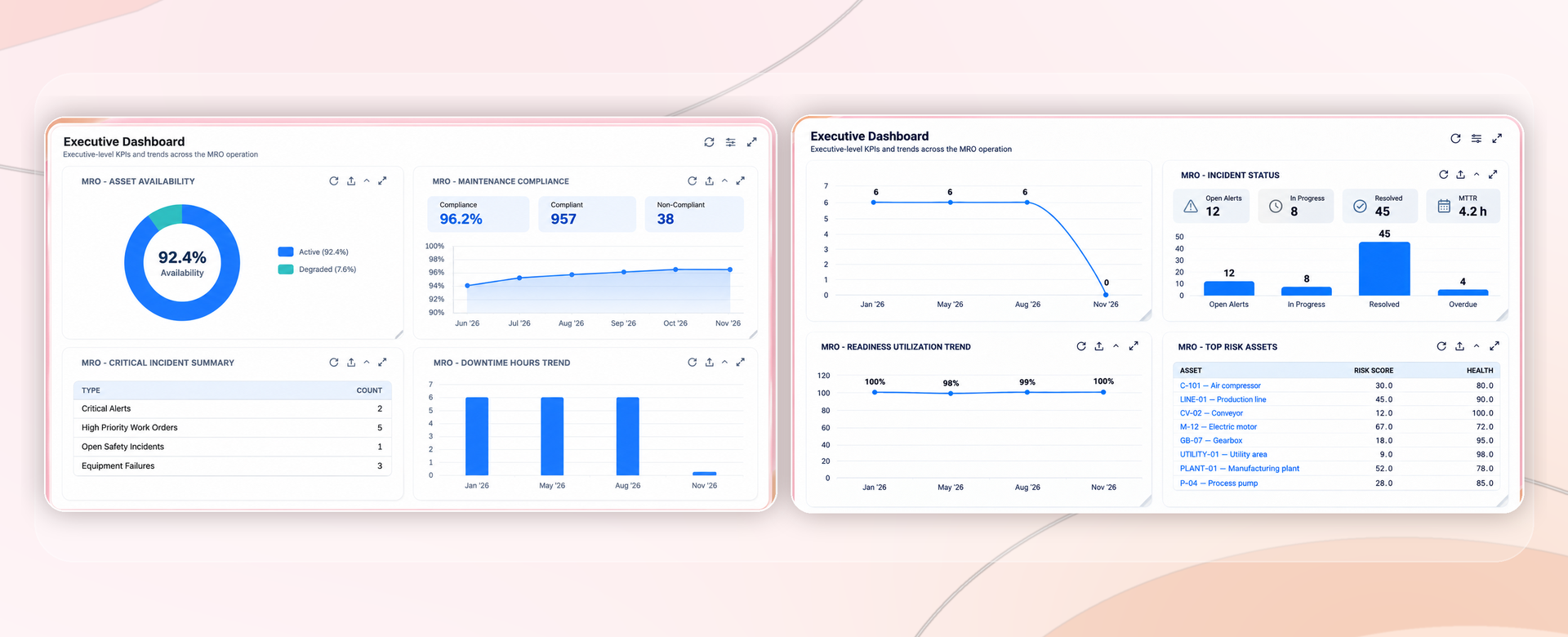
Every unavailable asset has a story. The fault may already be diagnosed, but the repair may be waiting on a part. The repair may be complete, but evidence may be missing. An inspection may be pending. An approval may be required. A component may be under repair or quarantine. The difference between “work in progress” and a precise blocking reason has enormous operational value.
When the blocker is visible, the organization can act on the constraint rather than merely watch the work order age. Procurement can expedite a critical part. An inspector can prioritize a release. A supervisor can reassign a technician. Operations can change the sequence of work. The MRO system becomes useful not because it stores more detail, but because it exposes the next actionable dependency.
Inventory availability is often more nuanced than an on-hand quantity. A serialized component may physically exist but be under inspection, reserved, quarantined, under repair or unsuitable for the required configuration. A generic warehouse balance can therefore create false confidence if it is not connected to maintenance context.
For critical maintenance, the useful question is not “Do we have stock?” but “Do we have the right serviceable item, in the right state, for this asset, when we need it?” Connecting maintenance demand with the real status of repairable and critical spares can shorten restoration time and reduce the tendency to compensate for uncertainty by carrying excess inventory.
Overdue preventive work deserves attention, but not every overdue task carries the same consequence. The value comes from combining due status with asset criticality, operational dependence and known risk. A small number of overdue activities may matter far more than a large backlog of low-impact tasks.
Repeat failures tell another important story. If the same component, symptom or system repeatedly triggers maintenance, the organization needs to see the pattern rather than treat each occurrence as an isolated job. That is the beginning of reliability improvement: moving from closing work to learning from work.
Maintenance can alter the operational configuration of an asset. Components are removed, substituted, repaired and reinstalled. Settings may change. Temporary conditions may be introduced. In controlled environments, knowing that a job was completed is not always enough; teams also need confidence in what changed and what is installed now.
Evidence matters for the same reason. A status field is a statement. A test result, inspection record, photo, certificate or authorized sign-off can provide assurance behind that statement. The more critical the operation, the more important it becomes to distinguish between administrative completion and evidence-backed readiness.
A readiness-driven MRO environment should not be limited to explaining yesterday. It should help teams notice developing conditions: abnormal sensor events, repeated minor failures, growing backlog around a critical system, a part shortage, delayed inspection or a pattern of exceptions. None of these automatically predicts failure, but together they can help teams decide where attention is most valuable.
This is where connected events, analytics and AI can assist - not by replacing engineering judgment, but by helping people see context earlier. The goal is a shorter path from signal to understanding to intervention.
If these ten questions can be answered quickly and consistently, the organization is already operating with a strong level of maintenance transparency. If they require multiple logins, spreadsheets, phone calls and experienced individuals who “know where to look,” there is a clear modernization opportunity.
The next step does not have to be a system replacement. It can begin with identifying the questions that matter most, mapping where the answers live today and designing an operational view that connects the required evidence. MRO modernization becomes far more practical when it starts from decisions rather than modules.
Imagine the first coordination meeting after a weekend shutdown. Production wants to know whether the line can start on time. Maintenance knows that most planned jobs are complete. Stores knows that one critical replacement item arrived late. Quality knows an inspection is still pending. A technician remembers a vibration alert that occurred during testing. None of these facts is wrong, but readiness depends on combining them.
In a low-maturity environment, the meeting itself becomes the integration mechanism. People search screens, call colleagues and update a spreadsheet while the start decision waits. In a readiness-driven environment, the same facts are already related to the affected asset and the unresolved blocker is visible before the meeting begins. The improvement is not merely faster reporting; it is faster operational decision-making.
Do not measure only whether an answer exists. Measure how long it takes to obtain, how many systems or people are involved, whether different users produce the same answer, and whether the underlying evidence can be reached quickly. These measures expose decision friction.
A useful baseline can be surprisingly simple: choose five critical assets, ask the ten questions at the start of each shift for two weeks, and record where the answers came from. If the same questions repeatedly require reconciliation, those are strong candidates for the first MRO improvement. The exercise also prevents the program from being driven by whichever feature happens to be easiest to demonstrate.
Begin with one operational decision, not a visual design workshop. For example: “Can Line 2 start at 06:00 tomorrow?” Identify the facts required to answer that question, who owns each fact and where it lives today. Then design the minimum view and workflow required to make that answer trustworthy.
This approach keeps the project outcome-driven. It also creates a natural filter for information: if a data point does not help establish readiness, explain a blocker or support an action, it does not need to be on the first screen. The result is usually simpler than a traditional dashboard program and more useful to the people making decisions.
Good practice around decision-ready maintenance visibility is visible when the same readiness answer is produced consistently by maintenance, stores and operations, with drill-down to the evidence behind it. That operating condition matters because it makes the information usable across shifts and roles, not merely correct inside one application. It also gives managers a stable basis for prioritization: people can act on the same operational truth instead of spending the first part of every escalation establishing what is happening.
The opposite pattern is equally revealing: the answer changes depending on who is asked or requires a spreadsheet to reconcile system states. When that happens, the organization is carrying hidden coordination cost and decision risk even if all of the underlying systems are technically functioning. The gap is often accepted as “how operations work,” which is exactly why it survives for years. Making the gap visible is the first step toward improving it.
A business case should baseline time to answer the ten questions, number of systems touched, number of people contacted, and frequency of conflicting answers. These measures do not need to be perfect on day one; a consistent directional baseline is enough to show whether the new operating approach is improving the situation. Where a financial value can be estimated credibly, translate time or disruption into cost. Where it cannot, keep the measure operational rather than inventing a number.
Avoid inflated claims that every delay, failure or escalation will disappear. The strongest MRO case isolates the portion of time, effort, inventory, downtime or risk that the proposed change can reasonably influence. It then measures the same signals after adoption. This produces a more defensible story for finance and leadership and makes it easier to decide whether the capability should be expanded.
A sensible first step is to run the ten-question test on five critical assets for two weeks and record every source used to produce each answer. Keep the scope narrow enough that the team can trace the complete process and understand cause and effect. The first use case should matter to operations, have an accountable owner and have enough recent history to create a baseline.
Once the organization can show a better outcome on a meaningful use case, expansion becomes a business decision backed by evidence rather than a technology roadmap based on assumptions. That progressive approach is also the best protection against overengineering: capabilities are added because the operation has demonstrated a need for them.
The strategic point is not to maximize technology around decision-ready maintenance visibility. It is to reduce the distance between an operational condition and a confident response. Leaders should expect the MRO environment to make the important state visible, explain the constraint, preserve the evidence and direct attention to the next action. When that happens consistently, maintenance begins to operate as a readiness capability rather than a collection of transactions.
At PIPRA Solutions, we use this kind of diagnostic thinking to frame conversations around Pi MRO. The objective is to understand where operational decisions are being delayed by fragmented maintenance information and where a connected readiness view can create measurable value.
A useful first step is an MRO & Operational Readiness Assessment: identify the ten questions your organization must answer every day, measure how long those answers take today, and decide which gaps are worth solving first.