


Manufacturing success often depends on one simple but powerful thing: clarity before production begins.
Every manufacturer understands the importance of drawings. CAD drawings, engineering drawings, and technical layouts carry the intent of what needs to be produced. They define shapes, measurements, components, quantities, tolerances, and manufacturing expectations. But in many organizations, these drawings still require extensive manual interpretation before they can be converted into production-ready decisions.
This creates a hidden operational challenge.
A drawing may be accurate, but the process of understanding it can still be slow, dependent on experience, and vulnerable to human oversight. Teams often spend significant time reviewing drawings, identifying assets, calculating dimensions, estimating quantities, and clarifying assumptions between design, procurement, planning, and production teams.
When this interpretation is incomplete or delayed, manufacturing surprises begin.
A component may be missed. A dimension may be misunderstood. A quantity may be underestimated. A material requirement may be discovered late. These gaps may look small at the beginning, but they can quickly lead to cost overruns, rework, production delays, procurement issues, and customer dissatisfaction.
Whether it is a growing manufacturer handling custom orders or a large enterprise managing complex production workflows, the need is the same: reduce ambiguity before production begins.
In many manufacturing environments, the pre-production process still depends heavily on manual effort.
A typical workflow may look like this:
The design or customer team shares a CAD drawing. The engineering or planning team studies it. The production team interprets what needs to be manufactured. The procurement team estimates material requirements. The operations team aligns resources. Then production begins.
This process works but it is not always efficient.
The challenge is not that people lack capability. In fact, experienced manufacturing professionals are very good at reading drawings. The challenge is that manual interpretation does not scale easily. As order volumes increase, product complexity grows, and turnaround expectations become shorter, relying only on human review creates bottlenecks.
Over time, these inefficiencies directly impact profitability.
A small mistake at the drawing analysis stage can become a large problem on the shop floor.
Artificial Intelligence is now making it possible to rethink how manufacturers work with CAD drawings.
Instead of treating drawings as static documents that need manual review, AI can help transform them into structured, actionable intelligence. This does not mean replacing engineers or production planners. It means giving them a faster, smarter way to understand what the drawing contains and what decisions need to be made.
At PIPRA Solutions, our team has developed a proof of concept that applies AI-based vision capabilities to analyze CAD drawings and identify assets along with relevant dimensional information.
One of the most time-consuming tasks in piping and process plant projects is generating a Bill of Quantities (BOQ) from Piping Isometric (ISO) drawings. These drawings contain critical information about pipe segments, fittings, flanges, elbows, and other components all of which must be accurately identified and counted before procurement and fabrication can begin.
Traditionally, this requires experienced engineers to manually trace each line, identify every component, and tally quantities a process that is slow, error-prone, and heavily dependent on individual expertise. Our AI vision model changes this fundamentally.
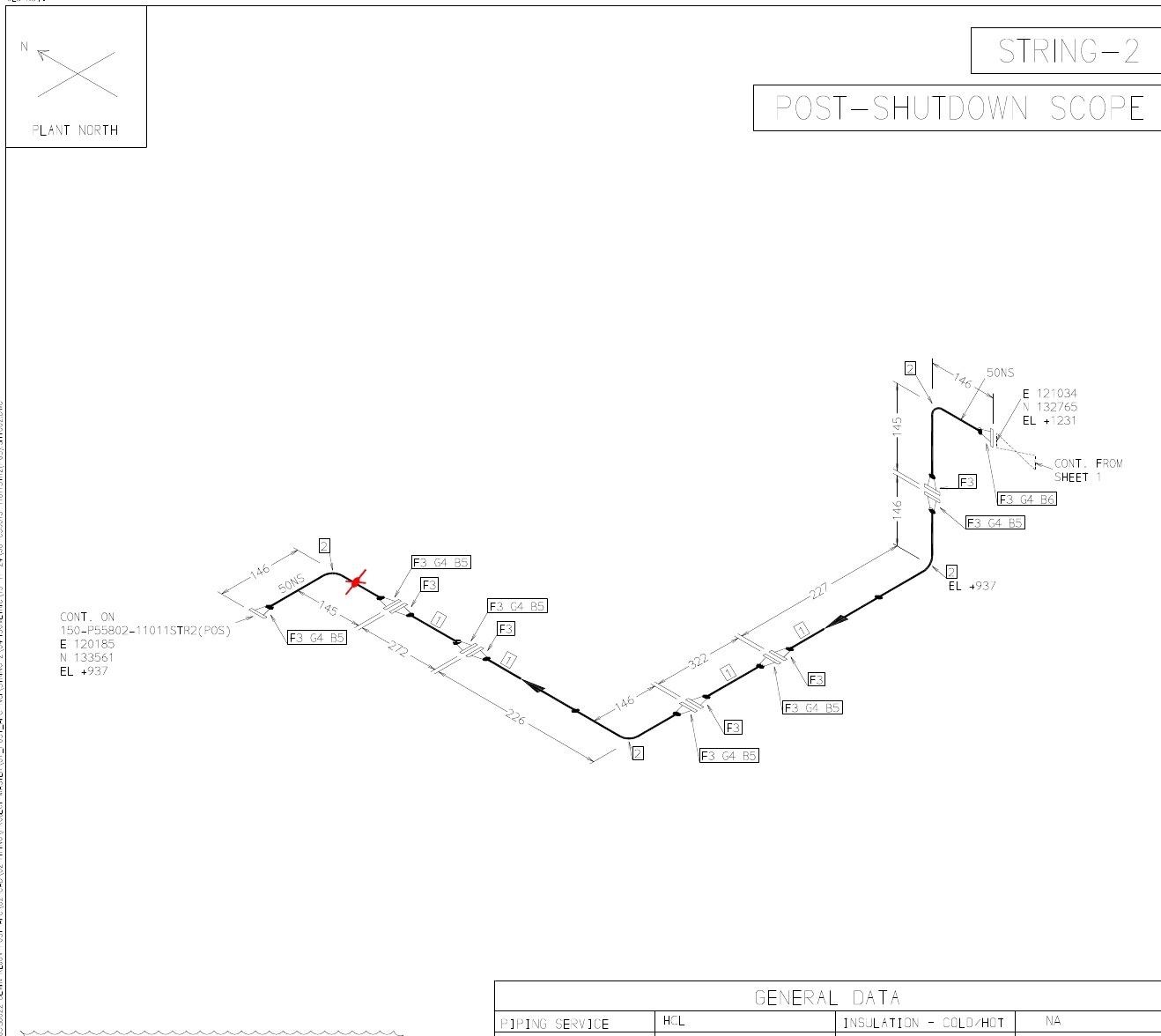
The diagram below shows a real Piping ISO drawing for STRING-2, Post-Shutdown Scope (HCL piping service). This is the raw input that our AI model receives a standard isometric layout showing pipe segments, bends, flanges, and support annotations across multiple elevation levels.
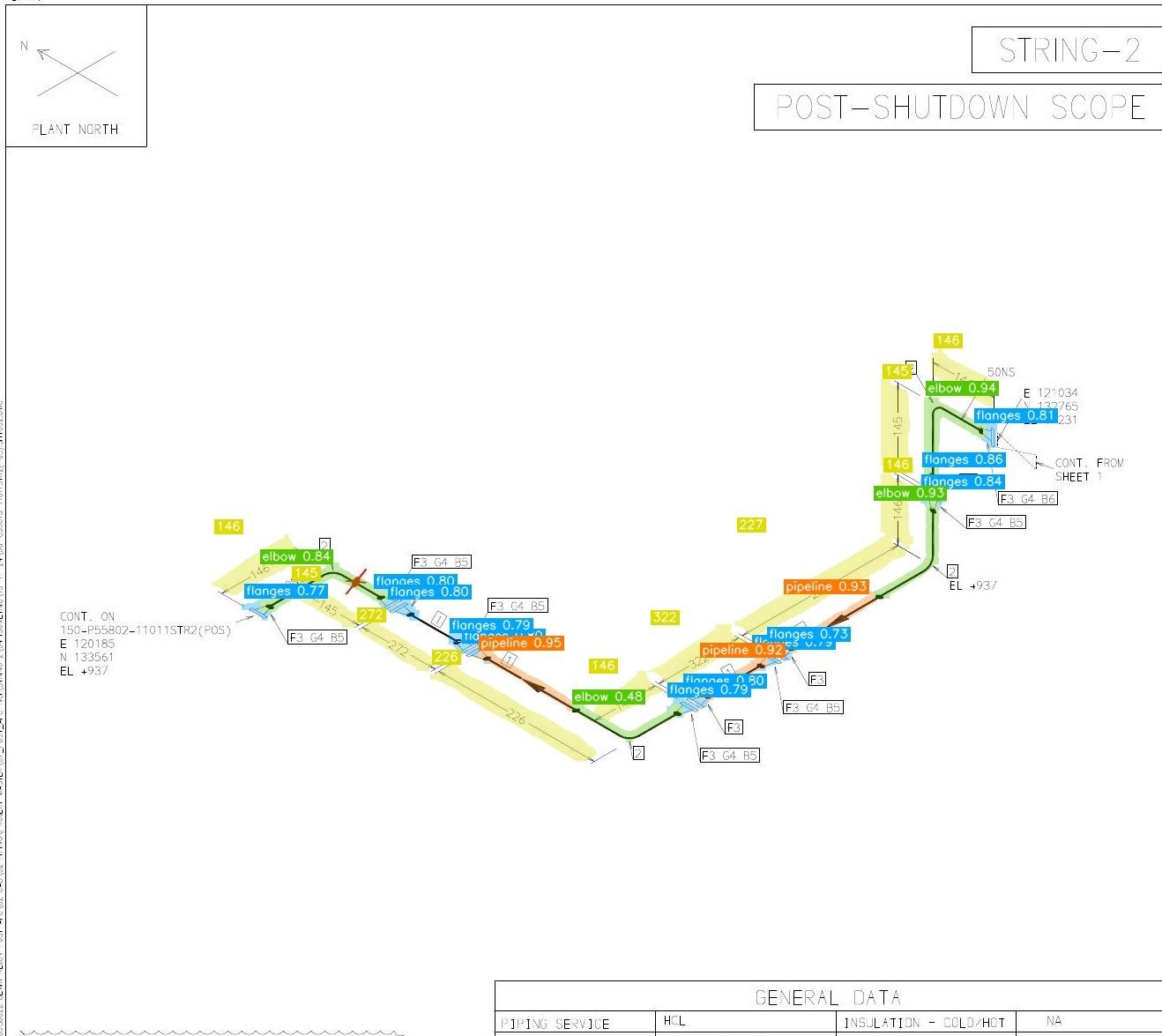
The diagram below shows what our AI model produces after processing the same drawing. Each asset pipelines, elbows, and flanges is automatically detected, labelled, and assigned a confidence score. Dimension annotations (segment lengths such as 146, 145, 272, 226, 322, and 227) are also extracted and linked to the corresponding pipe segments. This structured output can be directly used to generate a BOQ, eliminating the need for manual counting and dramatically reducing the risk of missed components.
Help manufacturers understand what needs to be produced, in what quantity, and with what level of clarity much earlier in the process.
This kind of AI-assisted analysis can support teams in moving from assumption-based planning to insight-led planning.
Rather than spending excessive time manually identifying drawing elements, teams can use AI as an intelligent assistant that highlights important details, accelerates review, and reduces the chance of surprises later in the production cycle.
For manufacturing companies, the value of AI is not in the technology itself. The value is in the operational outcome.
When AI helps interpret drawings faster and more consistently, it can improve multiple business areas.
Teams can move more quickly from drawing review to production planning. This helps reduce delays between receiving a customer requirement and preparing for execution.
When assets and components are identified more clearly, teams can estimate manufacturing quantities with greater confidence.
Early visibility reduces the likelihood of discovering missing parts, overlooked components, or misunderstood dimensions during production.
Design, planning, procurement, and production teams can work from a more consistent understanding of the drawing.
When production planning becomes more predictable, manufacturers can give more realistic timelines and improve customer confidence.
One important point must be made clear: AI is not here to replace manufacturing expertise.
It is here to support it.
Experienced engineers and production planners bring judgment, domain understanding, and contextual awareness. AI brings speed, consistency, and pattern recognition. Together, they create a stronger operating model.
The real opportunity is not to remove humans from the process, but to reduce repetitive effort and free experts to focus on higher-value decisions.
Instead of spending time only identifying and checking drawing details, teams can spend more time on planning, optimization, quality, and customer delivery.
Manufacturing is becoming more complex across industries.
Customers expect faster delivery. Product variants are increasing. Engineering-to-order and make-to-order models are becoming more common. Production teams are expected to handle higher complexity without increasing errors or delays.
In this environment, drawing intelligence becomes a strategic capability.
Manufacturers that can quickly understand technical drawings, validate requirements, estimate quantities, and identify production implications will have a clear execution advantage.
This is especially relevant for organizations dealing with:
In all these scenarios, better drawing understanding leads to better planning.
Manufacturing competitiveness is no longer only about machinery, manpower, or production capacity. It is increasingly about how quickly and accurately a business can convert information into action.
CAD drawings are a critical source of information. But when they remain locked in manual interpretation cycles, they slow down decision-making.
AI changes that equation.
It helps manufacturers move from drawings to decisions faster.
If your manufacturing team regularly works with CAD drawings and wants to reduce planning delays, missed details, and production surprises, PIPRA Solutions can help you explore how AI-assisted drawing intelligence may fit into your workflow.
Connect with PIPRA Solutions to discuss how AI can bring more predictability into your manufacturing operations.