
India's lending ecosystem is becoming more digital, more connected and more data-intensive. A single lending journey can touch mobile applications, digital KYC, payment systems, credit bureaus, bank transaction data, GST information, customer communications and multiple internal platforms.
For NBFCs, this creates both an opportunity and a challenge. The opportunity is to understand customers and portfolios with far greater depth. The challenge is that valuable information is often spread across systems, documents and operational silos. Data may exist, yet still arrive too late - or in the wrong form - to improve a decision.
The strategic shift is therefore not simply from paper to digital. It is from data storage to decision intelligence: the ability to combine trusted data, AI/ML models, analytics and workflow automation so that the right insight reaches the right user at the right moment.
Traditional database platforms remain essential. They provide the reliable system of record that lending applications need to store, retrieve, secure and process transactional information. But database technology by itself does not solve the full business problem facing a modern lender.
An NBFC does not merely need to know what happened. It increasingly needs to understand what is likely to happen next, why an exception occurred, which case deserves attention, what document is missing, where risk is building and what action should follow.
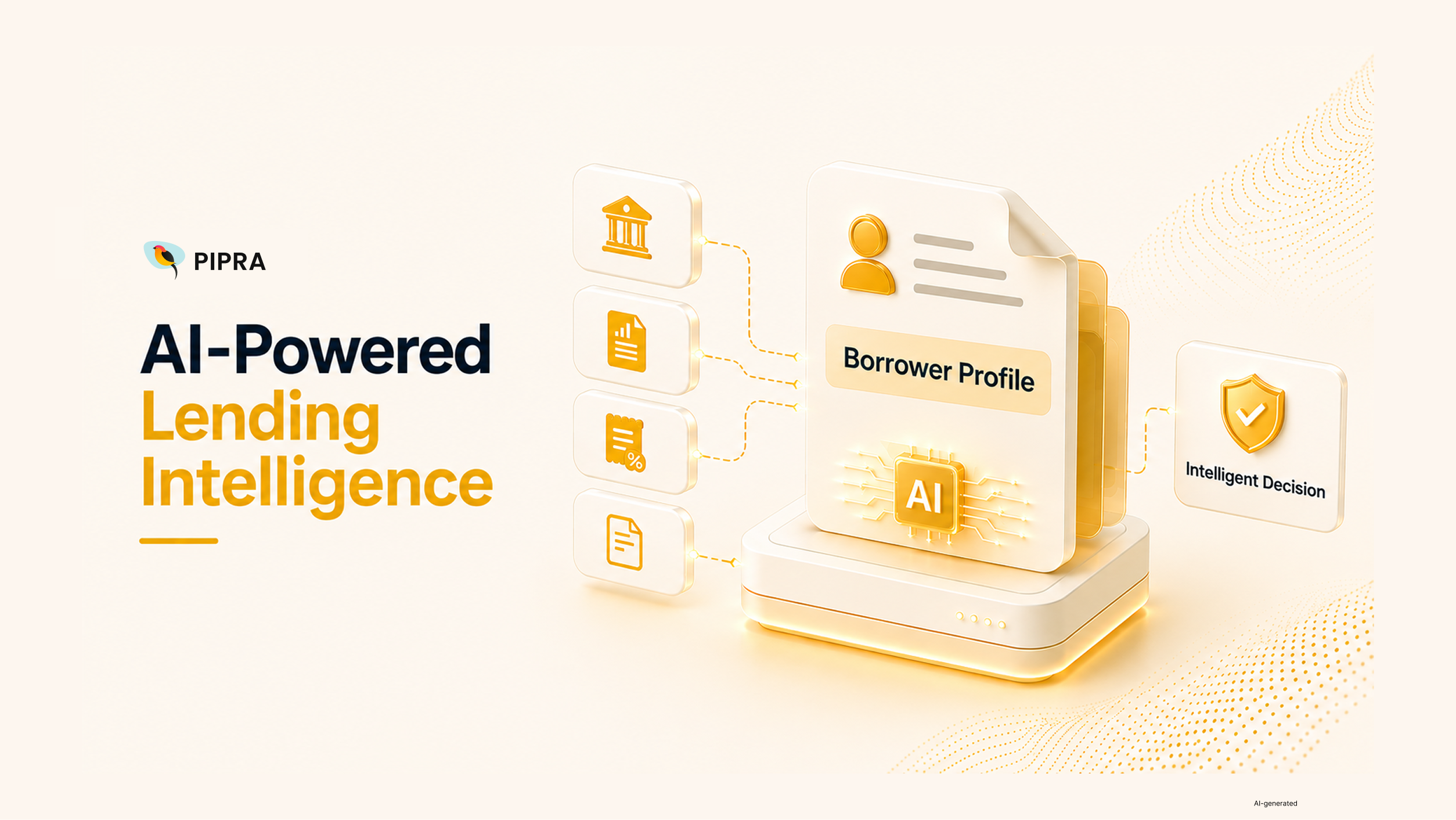
An intelligent lending architecture brings together data integration, AI/ML, document intelligence, workflow automation and analytics. It can sit alongside existing core lending applications rather than forcing a wholesale replacement.
The objective is to make data continuously useful across onboarding, underwriting, disbursement, servicing, portfolio monitoring, collections, compliance and customer engagement. The value comes not from making the database itself the product, but from turning trusted enterprise data into operational decisions and actions.
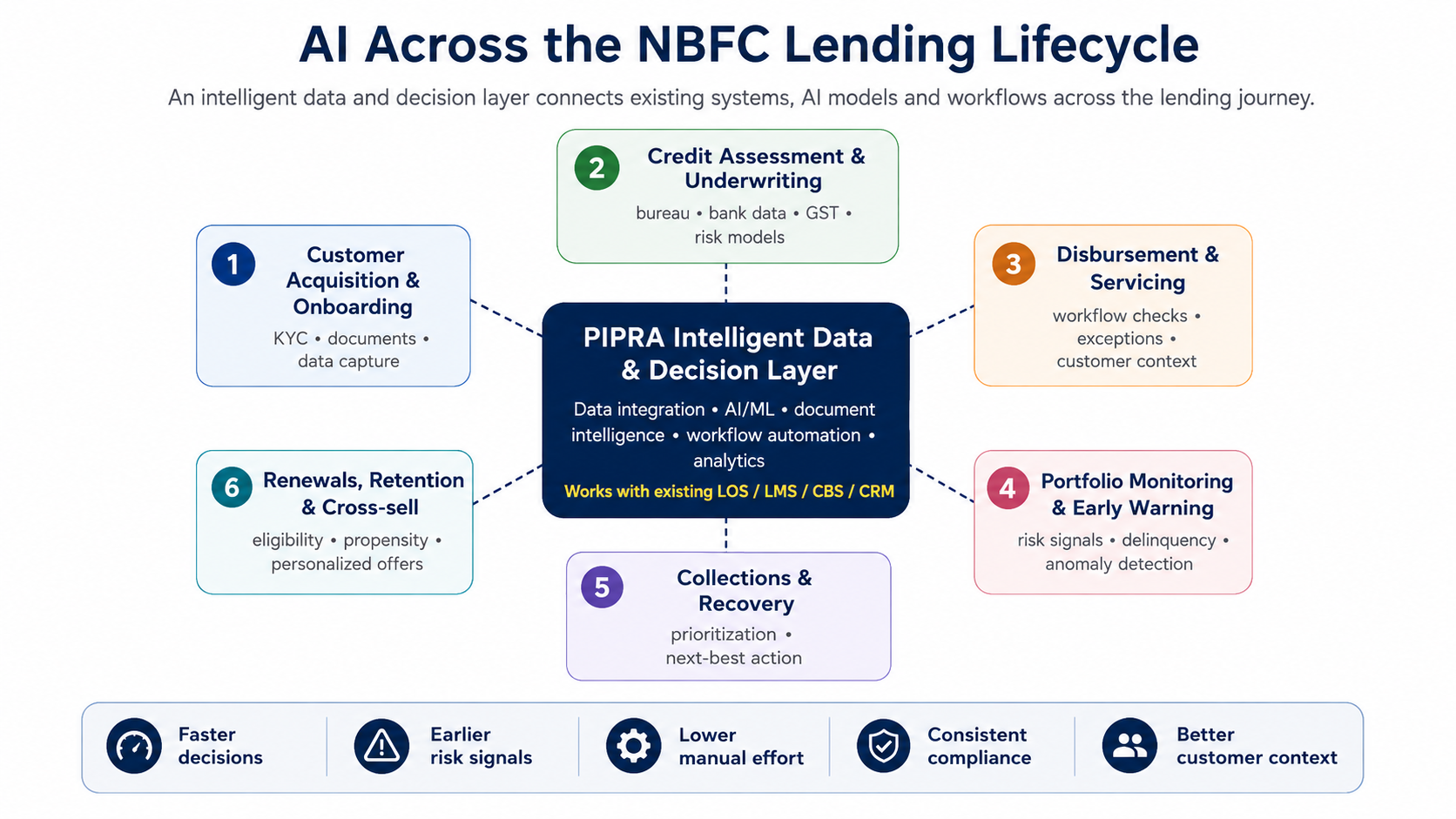
Bring together approved internal and external data sources to build a richer borrower context. AI/ML models can assist with affordability assessment, risk segmentation and underwriting consistency while preserving policy controls and human review where required.
Analyse identity, device, application, transaction and document signals to surface unusual patterns for investigation. The goal is not to replace controls, but to focus attention on cases that warrant earlier review.
Use repayment behaviour and portfolio history to identify deteriorating risk signals before they become visible in conventional periodic reporting. Early-warning alerts can help relationship, risk and collections teams prioritize intervention.
Combine data validation, evidence capture, workflow controls and reporting so that policy adherence is easier to demonstrate. AI can assist with document review and exception detection, while final control ownership remains governed by the institution.
Apply OCR and Intelligent Document Processing to information such as KYC documents, bank statements, salary slips, GST certificates, financial statements and loan agreements. Extracted information can feed downstream review and workflows, reducing re-keying and turnaround time.
Use approved customer and behavioural data to identify relevant offers, renewal opportunities, repayment options or service actions. Recommendations should operate within product, consent, policy and fairness guardrails.
Treat database tuning, storage, query performance, resilience and resource optimization as part of the data/cloud foundation. Managed cloud services and engineering automation can improve scale and operating efficiency without positioning the intelligence layer as a new database engine.
PIPRA's role is best positioned as the intelligence and modernization layer around an NBFC's existing lending ecosystem. This makes the proposition modular: an institution can start with one high-value use case and expand without replacing systems that continue to serve their purpose.
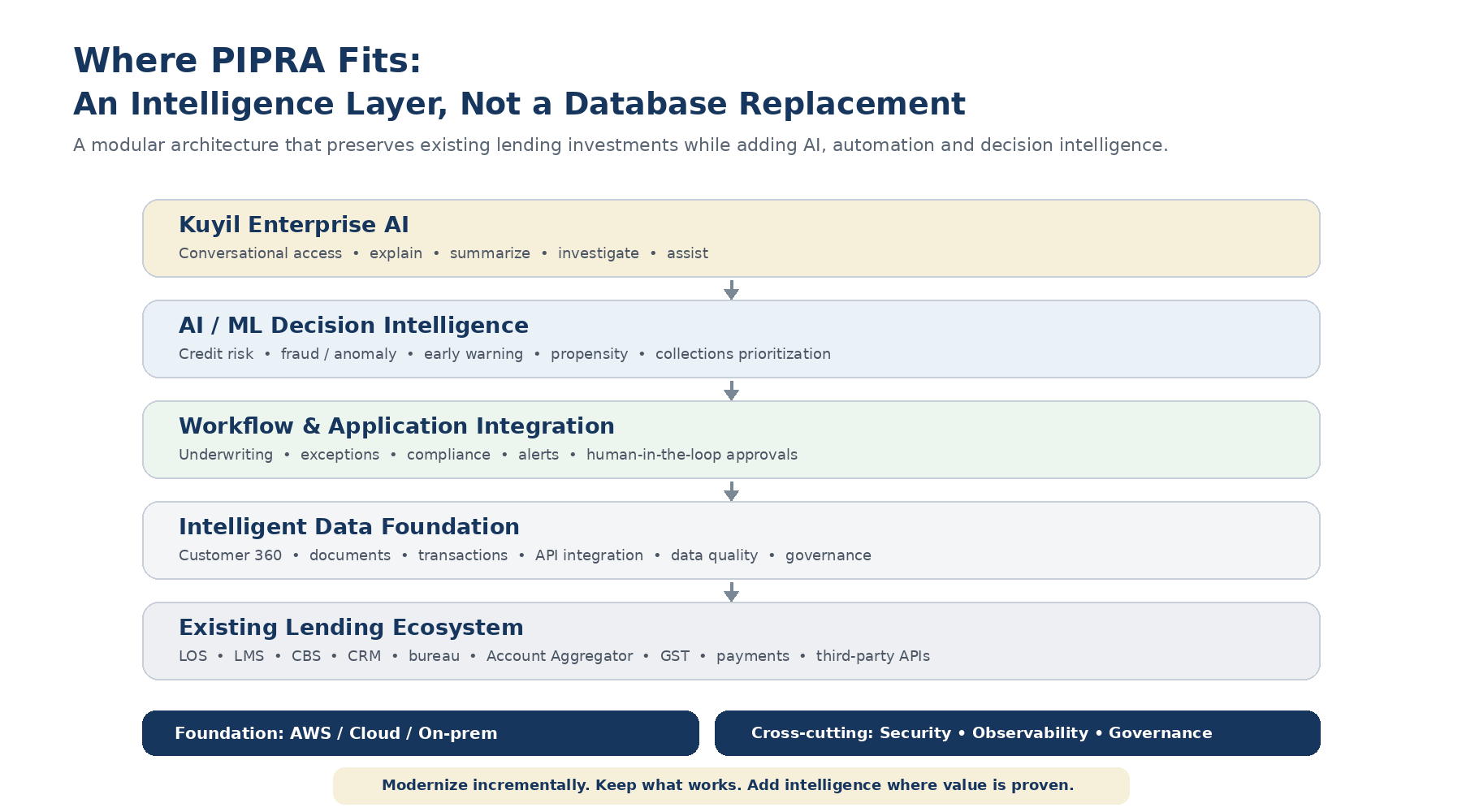
AI/ML capabilities can support risk modelling, anomaly detection, early-warning signals, document intelligence, recommendations and operational analytics. These capabilities are strongest when embedded into business workflows rather than delivered as isolated models.
Kuyil can provide a governed conversational layer over approved enterprise documents, databases and APIs. For lending teams, this can enable natural-language investigation, summarization and assisted decision support - for example, understanding a borrower context, exploring a portfolio movement or retrieving policy-backed answers without navigating multiple systems.
Cloud/data engineering, APIs, security, observability and application modernization provide the foundation required to connect existing systems, operationalize AI models and scale workloads reliably. The architecture can also be designed for hybrid or controlled deployment patterns where data or regulatory requirements demand them.
The most effective entry point is usually a focused business problem: an underwriting bottleneck, high manual document effort, a fraud pattern, delayed portfolio visibility or a collections prioritization challenge. Establish the baseline, connect the minimum data required, introduce AI assistance and measure the outcome.
Once a use case proves value, the same data and integration foundation can support the next one. This creates a practical path from isolated automation to enterprise-wide lending intelligence without turning modernization into a high-risk, all-at-once replacement programme.
The future of lending will be shaped by institutions that can convert data into timely, explainable and governed decisions. Databases will remain essential systems of record, but competitive advantage will increasingly come from the intelligence layer built around them.
For NBFCs, that means connecting data across the lending lifecycle, embedding AI into workflows, strengthening human decision-making and progressively automating the areas where policy and risk allow it. The result is not an 'AI database'. It is a more intelligent lending enterprise.
Reserve Bank of India (RBI)
TransUnion CIBIL
McKinsey & Company
Amazon Web Services
Microsoft
IBM
Deloitte Insights
NVIDIA